
A lot of chemical distributors assume SEO should be the foundation of their lead generation strategy.
On the surface, that makes sense.
If you sell citric acid, sodium hydroxide, propylene glycol, solvents, food-grade ingredients, specialty chemicals, or industrial products, it seems logical that your website should rank when someone searches for those products.
But in practice, SEO is often the wrong tool for the job.
Not because SEO is useless.
Because for many chemical distributors, the economics simply do not make sense.
Trying to rank for a broad chemical name like “citric acid” is like a small hardware supplier trying to rank for “hammers” against Home Depot, Amazon, Canadian Tire, Walmart, manufacturers, product databases, and review sites.
And trying to rank for hundreds of chemical names?
That can quickly become an expensive, slow, and unrealistic strategy.
For many chemical distributors, paid search is a much more practical lead generation channel.
The Search Volume Problem
One of the first things chemical companies need to understand is that many of the obvious search terms do not have much volume.
A phrase like:
chemical distributors in Canada
may only get a handful of searches in a month.
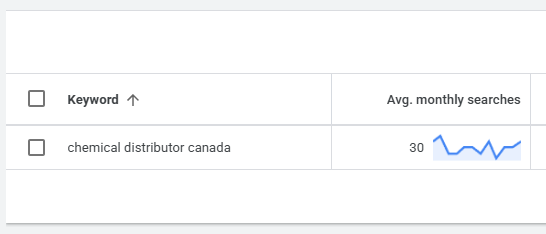
Even if your company could rank organically for that phrase, the opportunity may be too small to justify a major SEO investment.
That is the part that often gets missed.
You could rank fror this tomorrow with paid ads at about $3.00 per click!
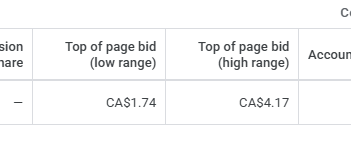
SEO takes time. It requires content, technical work, optimization, link authority, and ongoing effort. If the target keyword only produces limited monthly search volume, the return on that effort may not make sense. It could cost hundreds or thousands of dollars in landing pages, blog articles and link building to even stand a chance to rank for this keyword. You could essentiall buy ALL this traffic for approximately $120/month based on current estimates!
This is especially true if the company is trying to generate leads now.
A low-volume keyword can still be valuable — but it may be better suited to Google Ads than a long-term SEO campaign.
With paid search, you can show up for that keyword without spending months trying to rank for it. Plus, you only pay when someone clicks to your website. Just because this particular keyword gets searched 30 times a month in Canada doesn’t mean it gets clicked 30 times a month. It may only get clicked 10 times a month.
The Product Volume Problem
The second challenge is product count.
A typical chemical distributor may sell hundreds of products.
That creates a major SEO problem.
Are you really going to build, optimize, and rank pages for hundreds of competitive chemical names?
- Citric acid.
- Sodium hydroxide.
- Propylene glycol.
- Isopropyl alcohol.
- Acetone.
- Calcium chloride.
- Xanthan gum.
- Potassium sorbate.
- And on and on.
Each product may have different grades, applications, packaging options, regulatory considerations, and buyer intent.
Trying to win organic rankings for hundreds of chemical names is not a practical lead generation strategy for most distributors. This would require dedicated landing pages for each one, plus a considerable amount of backup content like blog articles for each chemical name.
It is insanity.
Not because product pages are bad. You still need product pages. But expecting those pages to organically outrank Wikipedia, scientific databases, academic sources, safety documentation, large manufacturers, marketplaces, and global distributors is a completely different challenge.
Paid search gives you another option.
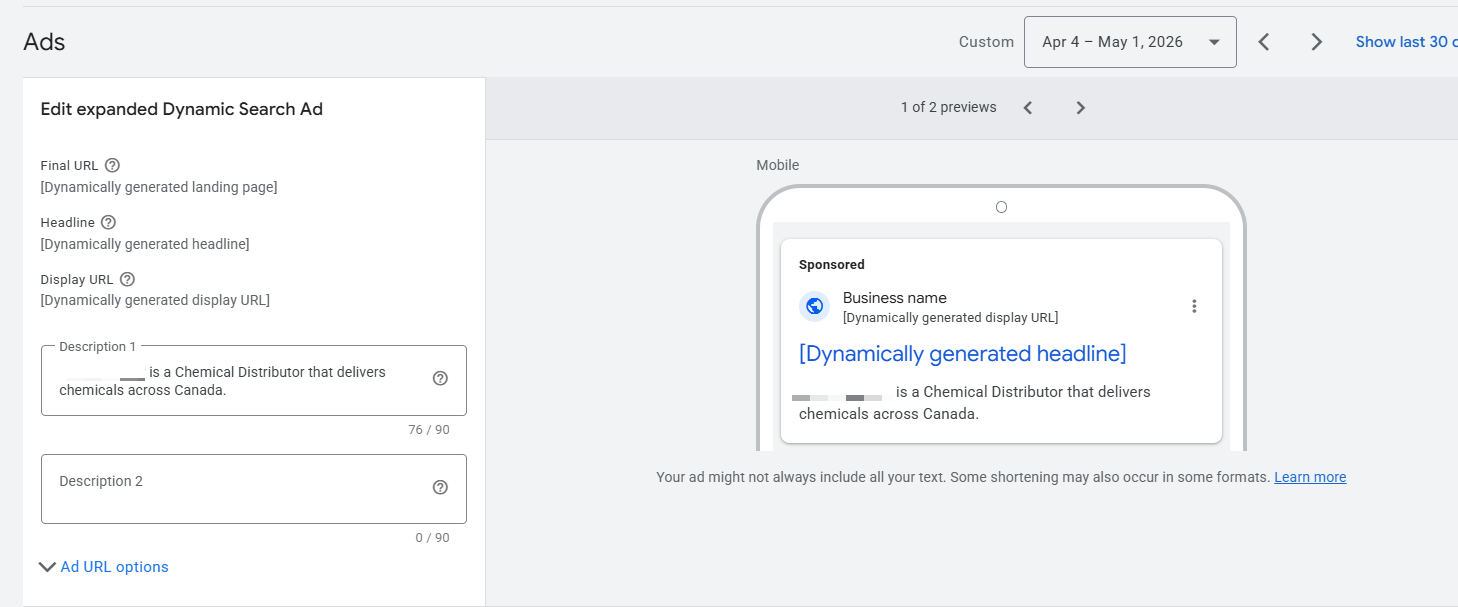
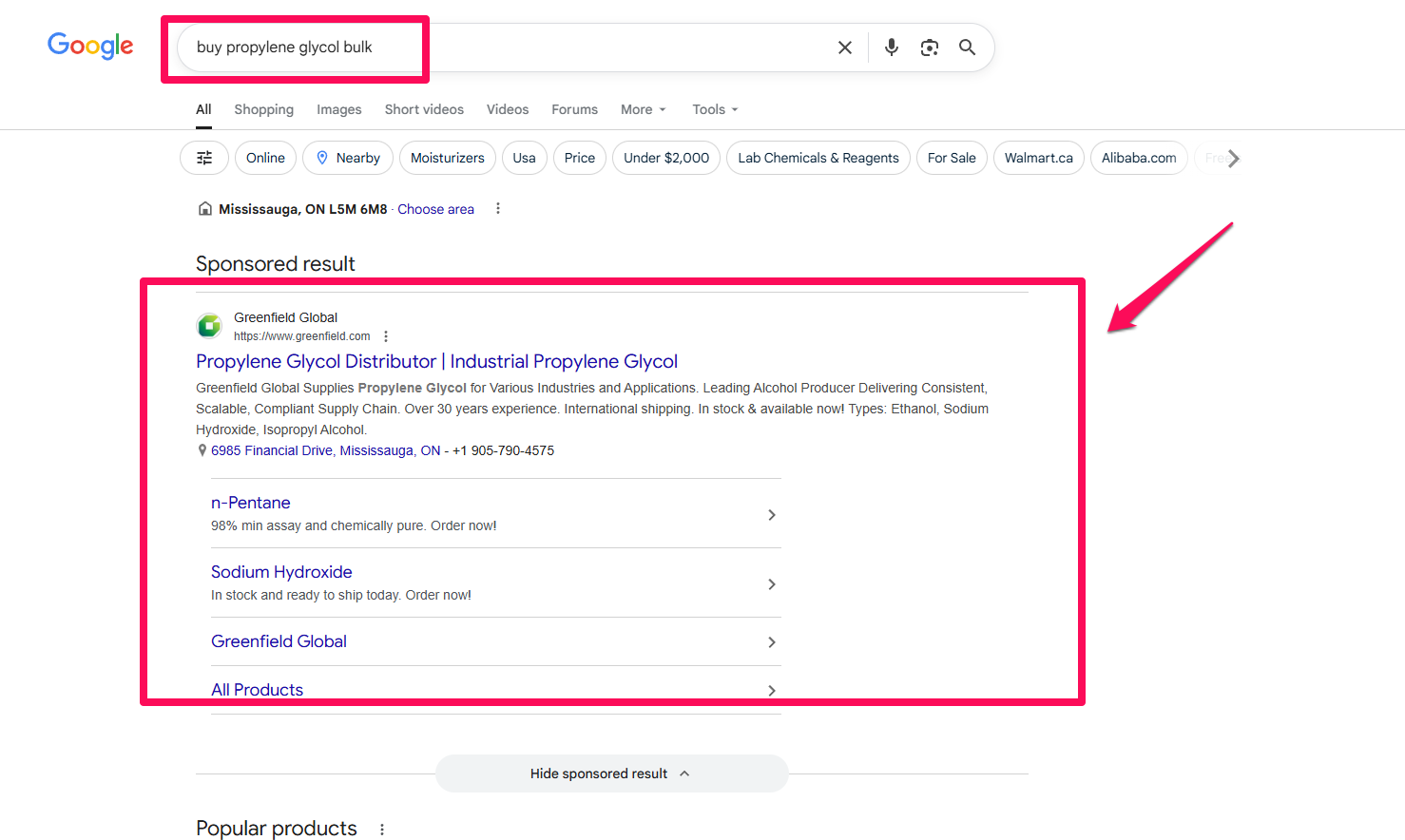
Instead of trying to rank organically for every product, you can build campaigns that serve ads based on the specific chemicals buyers are searching for. The chemical name can by dynamically inserted right in the ad.
Paid Search Matches the Economics Better
This is where Google Ads Pay Per Click can be very effective.
For low-volume, high-intent searches, paid search often makes more economic sense than SEO.
If only a small number of people search for a specific chemical supplier phrase each month, why spend months trying to rank organically?
Why not pay only when someone actually searches and clicks?
That is the advantage.
You can target buyer-intent searches like:
- buy citric acid bulk
- citric acid supplier Canada
- food grade citric acid distributor
- sodium hydroxide supplier Ontario
- propylene glycol quote
- bulk chemical supplier Toronto
- industrial chemical distributor Canada
Then the ad can match the search:
- Buy Citric Acid from XYZ Chemical
- Request Pricing for Sodium Hydroxide
- Food Grade Citric Acid Supplier
- Bulk Propylene Glycol Available
- Chemical Distributor Serving Canadian Manufacturers
That is much more practical than trying to rank organically for every product term.
You Do Not Need Thousands of Clicks
This is another important point.
Chemical distribution is not e-commerce for low-value consumer products.
You do not necessarily need thousands of visitors. You need qualified quote requests.
A single good lead could represent a large order, a recurring account, or a long-term supplier relationship.
That changes the math.
A campaign with low search volume can still be profitable if the clicks are highly relevant and the leads are properly followed up.
That is why paid search is such a good fit for niche B2B markets.
You can target specific chemicals, specific regions, specific industries, and specific buyer intent without having to win a massive SEO battle first.
SEO Still Has a Supporting Role
This does not mean chemical distributors should ignore SEO completely.
They still need a professional website. They still need clear product and category pages. They still need Google to understand what they supply.
But SEO should support the lead generation strategy, not carry the whole burden.
A distributor should have pages for key products and categories, but those pages should be built to convert buyers, not just chase rankings.
A good product landing page should answer practical sales questions:
- What chemical do you supply?
- What grades are available?
- What packaging options are available?
- What industries do you serve?
- What regions do you supply?
- Can the buyer request pricing?
- Can they ask about availability?
- Can they provide quantity and specifications?
- Can they speak to someone quickly?
The page should not just be an SEO article.
It should be a quote-generation page.
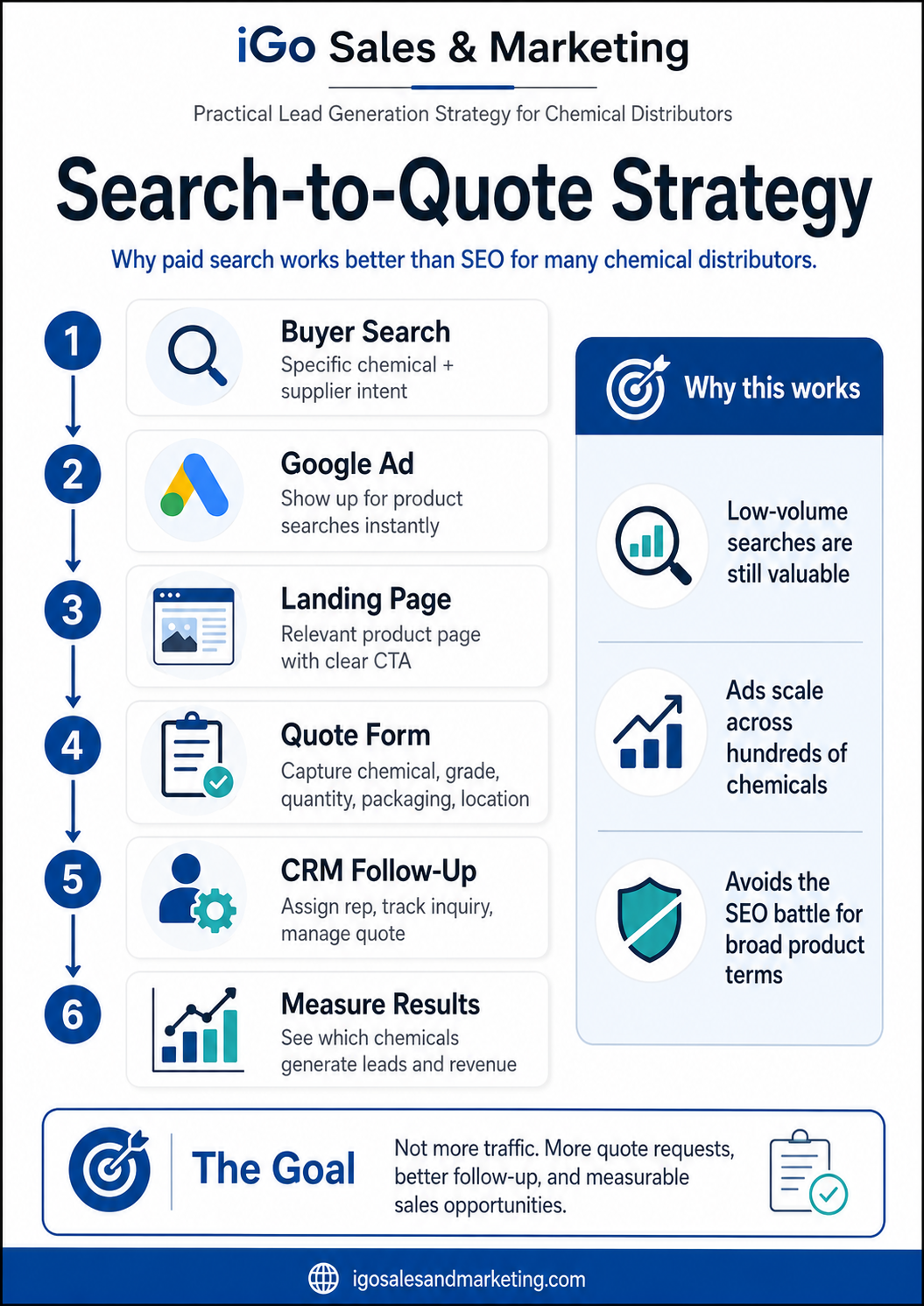
The Real Opportunity Is Search-to-Quote
The best strategy for chemical distributors is not simply SEO or ads.
It is a complete search-to-quote process.
- A buyer searches for a product.
- They see a relevant ad.
- They click through to a relevant page.
- They request pricing or availability.
- The inquiry is captured in the CRM.
- A sales rep follows up.
- The quote is tracked.
- The company learns which products and campaigns are generating real opportunities.
That is where the money is made.
- The ad gets the buyer’s attention.
- The landing page captures the inquiry.
- The CRM turns that inquiry into a measurable sales opportunity.
Without that process, even good leads can disappear into email inboxes, spreadsheets, or missed follow-ups.
The Practical Lead Generation Strategy
For most chemical distributors, the better strategy looks like this:
Start with paid search for high-intent product and supplier searches.
Build focused landing pages for key product categories.
Use ads that match the buyer’s search as closely as possible.
Capture product, grade, quantity, packaging, and location in the quote form.
Push every inquiry into the CRM.
Track which chemicals generate leads, quotes, and revenue.
Use that data to refine the campaign over time.
That is much more practical than trying to rank organically for hundreds of competitive chemical names.
Final Thought
SEO is not always the wrong strategy.
But for many chemical distributors, it is the wrong lead generation strategy.
The search volume for broad distributor terms may be too low. The competition for individual chemical names may be too high. And the product catalog may be too large to make organic ranking a realistic path to leads.
Paid search solves that problem.
It allows chemical distributors to show up for specific buyer-intent searches without waiting months or years for SEO results.
Instead of trying to outrank Wikipedia for “citric acid,” or trying to rank hundreds of product pages organically, a distributor can use targeted Google Ads to appear when buyers are actively looking for products, pricing, availability, and suppliers.
For chemical distributors, that is the better opportunity:
Not more traffic.
More quote requests.
More follow-up.
More measurable sales opportunities.