
Most CRM demos for education focus on lead capture and basic pipelines. But admissions teams know the truth: onboarding a student is a complex, multi-stage, compliance-driven process that extends far beyond a simple funnel.
Every applicant who falls through the cracks represents two losses: lost tuition revenue and wasted marketing spend. Institutions invest heavily to generate inquiries, but without a structured onboarding system, those leads can quietly disappear during application, document collection, or follow-up stages. A well-designed admissions system must not only move students forward—it must actively identify where they stall, surface those risks in real time, and systematically recover them before they are lost.
In this article, we explore how a purpose-built system can manage the entire student lifecycle from first inquiry to graduation using a structured, workflow-driven approach.
The Real Problem: Admissions Is Not a Pipeline
A typical admissions journey includes:
- Multiple inquiry channels (email, phone, chat, referrals)
- Follow-up cycles and engagement tracking
- Application submission deadlines
- Document collection and validation
- State-specific requirements
- Admissions review and approval
- Payment processing
- Enrollment and course tracking
- Instructor assignment and evaluations
Trying to manage this in spreadsheets or generic CRM pipelines leads to:
- Missed follow-ups
- Incomplete applications
- Poor visibility
- Administrative overload
A Better Approach: Designing Around the Workflow
Instead of forcing admissions into a CRM, we design the system around the institution’s real workflow.
Key Principle
The system should mirror how the institution actually operates — not how a generic CRM expects it to operate.
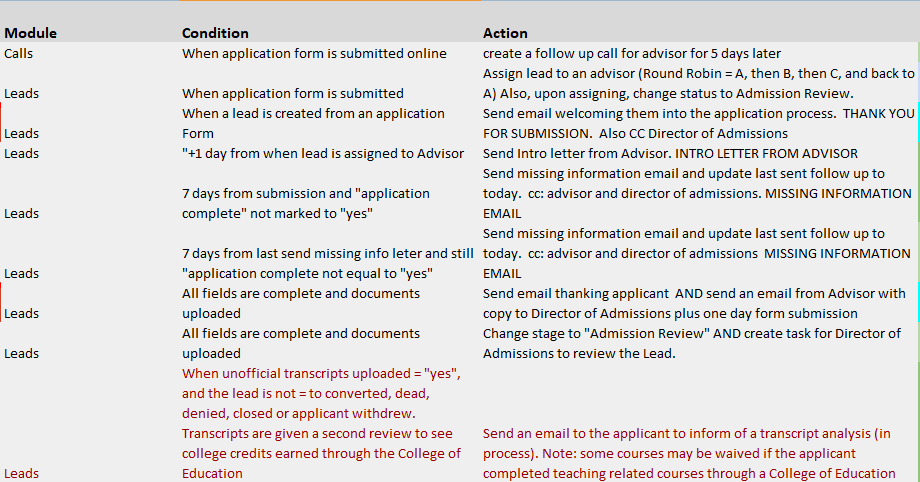
Below is an example of how workflow automation is structured behind the scenes. Each condition triggers specific actions, ensuring no applicant is missed and every step is consistently executed.
Stage 1: Inquiry & Lead Management
Students enter the system through multiple channels:
- Email inquiries
- Chat inquiries
- Phone calls
- Other sources
Each inquiry is:
- Assigned to an advisor
- Tracked from first contact
- Entered into a structured follow-up process
Smart Follow-Up Logic
If a candidate does not apply within a defined timeframe (e.g., 5 working days):
- Advisors initiate follow-up cycles
- Multiple touchpoints are tracked
- Candidates are eventually qualified as active or inactive
This ensures no opportunity is lost due to lack of follow-up.
Stage 2: Application Submission & Initial Review
Once a candidate submits an application:
- A structured record is created
- Key stakeholders are notified
- The admissions team begins review
The system tracks:
- Application completeness
- Submission timing
- Advisor involvement
Stage 3: Document Collection & Validation
This is where most systems break down.
Each student must submit required documentation, which may vary by state or program.
The system:
- Tracks required documents per student
- Flags missing items
- Maintains a checklist of requirements
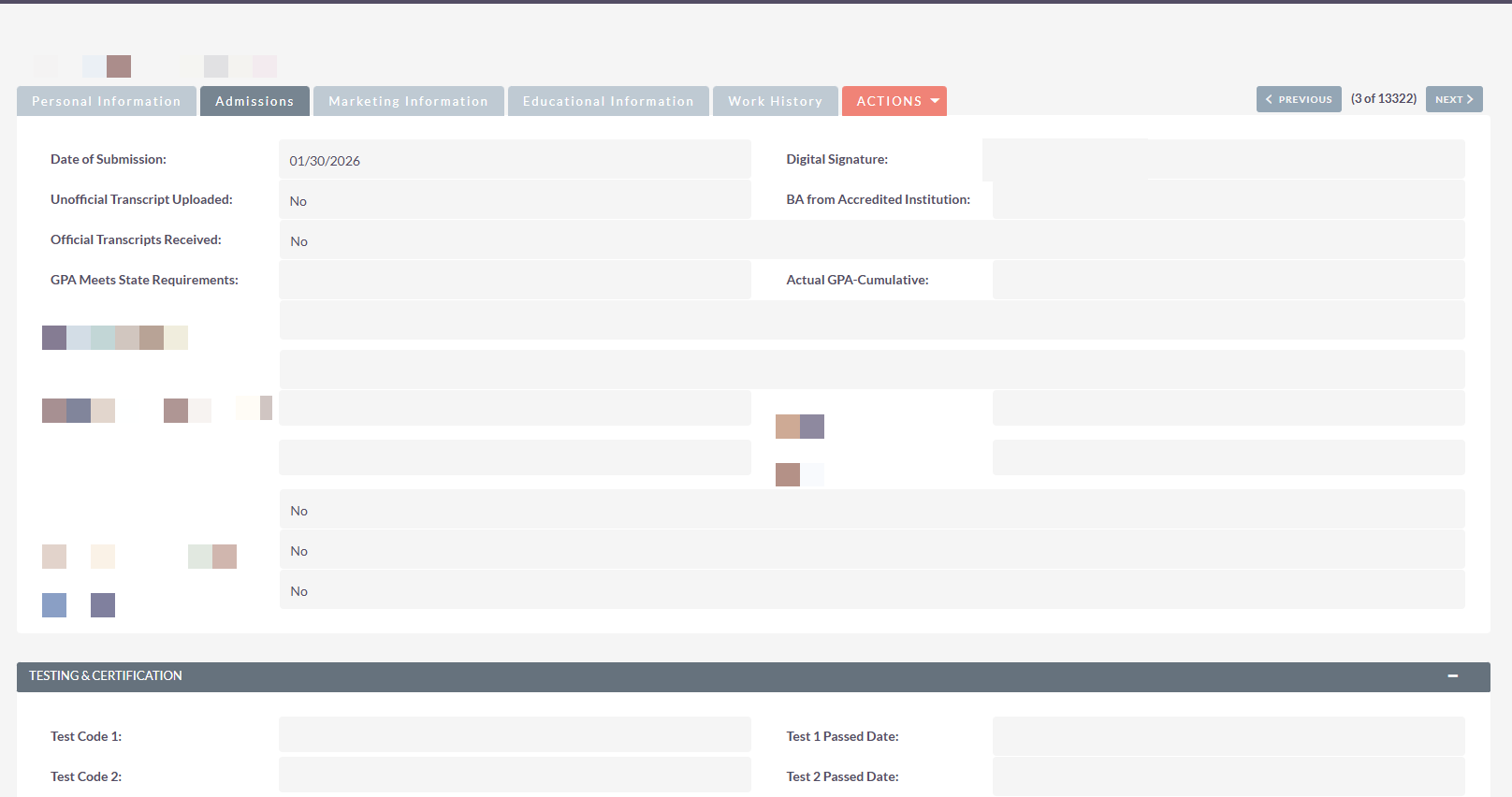
Here’s an example of an applicant record (with appropriate blurring of confidential info) to give you an idea of how all the information is visible on the student record.
Automated “Nagging” Engine
Instead of manual follow-ups:
- Weekly reminders are sent automatically
- Messaging is triggered based on missing items
- Students are continuously guided toward completion
The system doesn’t just store documents — it actively chases them.
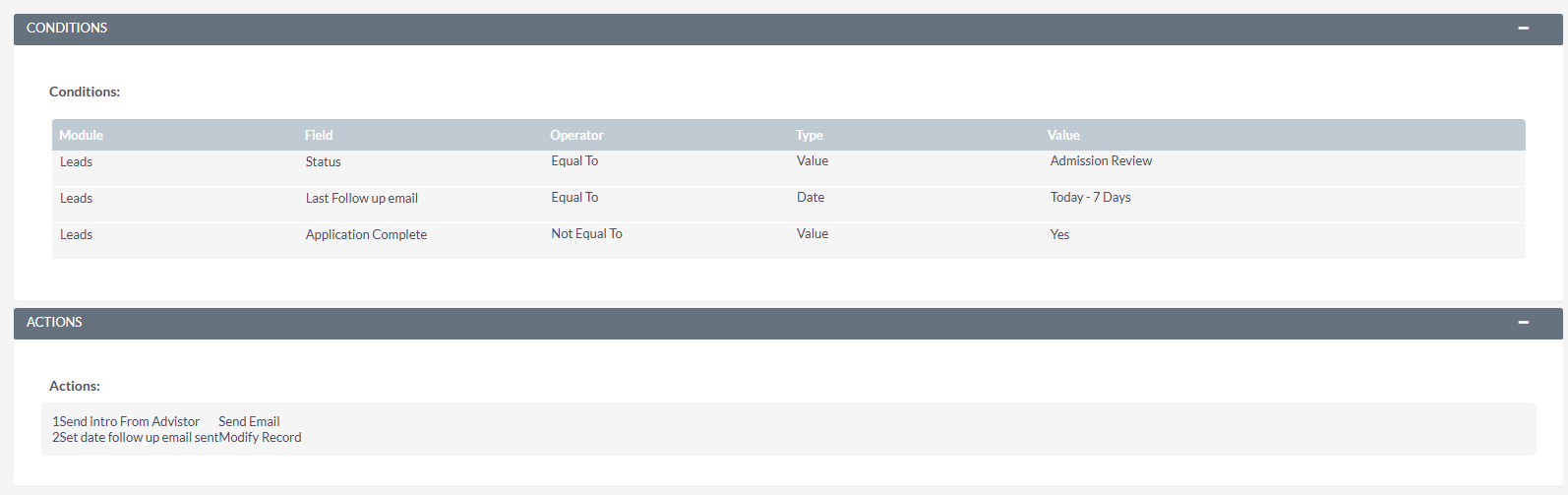
Here’s an example of an email follow up workflow in SuiteCRM.
Stage 4: Admissions Decision Logic
Once documentation is complete, the system evaluates eligibility criteria such as:
- Degree requirements
- Accreditation
- GPA thresholds
- Certification or test scores
Based on these rules:
- Students are approved
- Additional requirements are triggered
- Or applications are denied
Here’s an example of an admissions workflow that updates the record and sends the admissions letter.
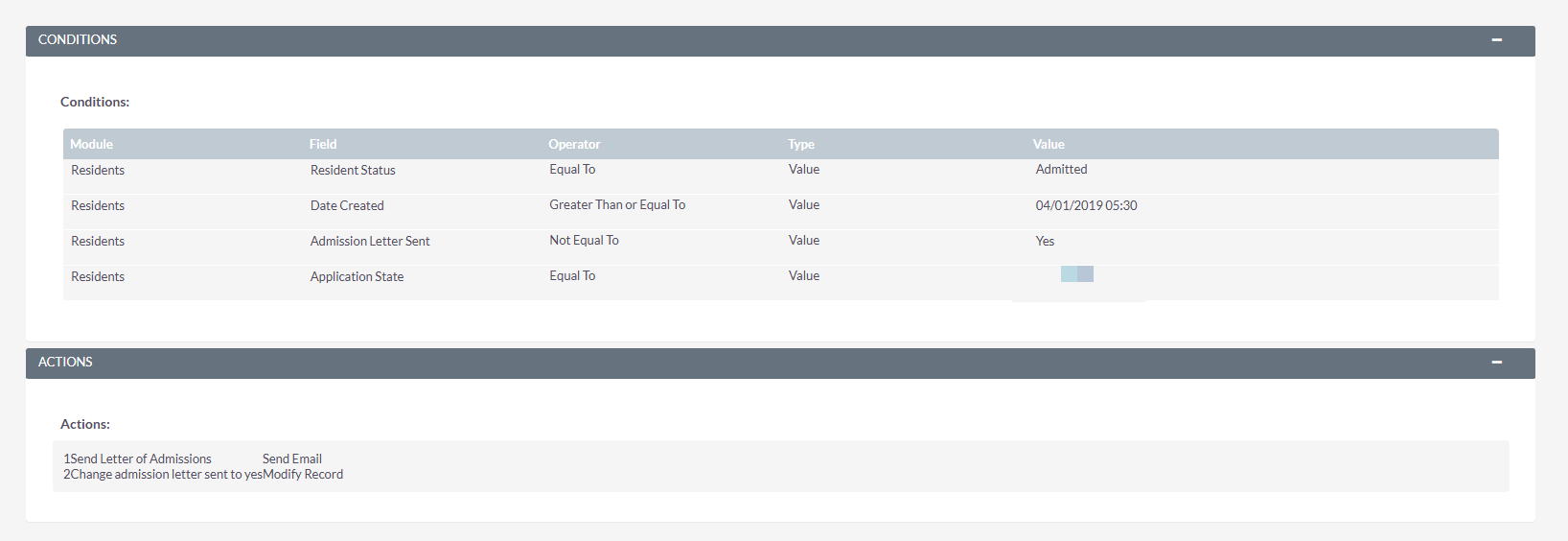
Conditional Workflows
Examples include:
- Retesting requirements if scores are insufficient
- Special handling for non-standard qualifications
This ensures consistent, rule-based decision-making.
Stage 5: Payment & Enrollment Workflow
After approval, students must:
- Pay in full, or
- Select a payment plan
The system ensures:
- No student proceeds without financial clearance
- Payment status is clearly tracked
- Enrollment only occurs once requirements are met
Here’s an example of an enrollment workflow once the student has met payment criteria.
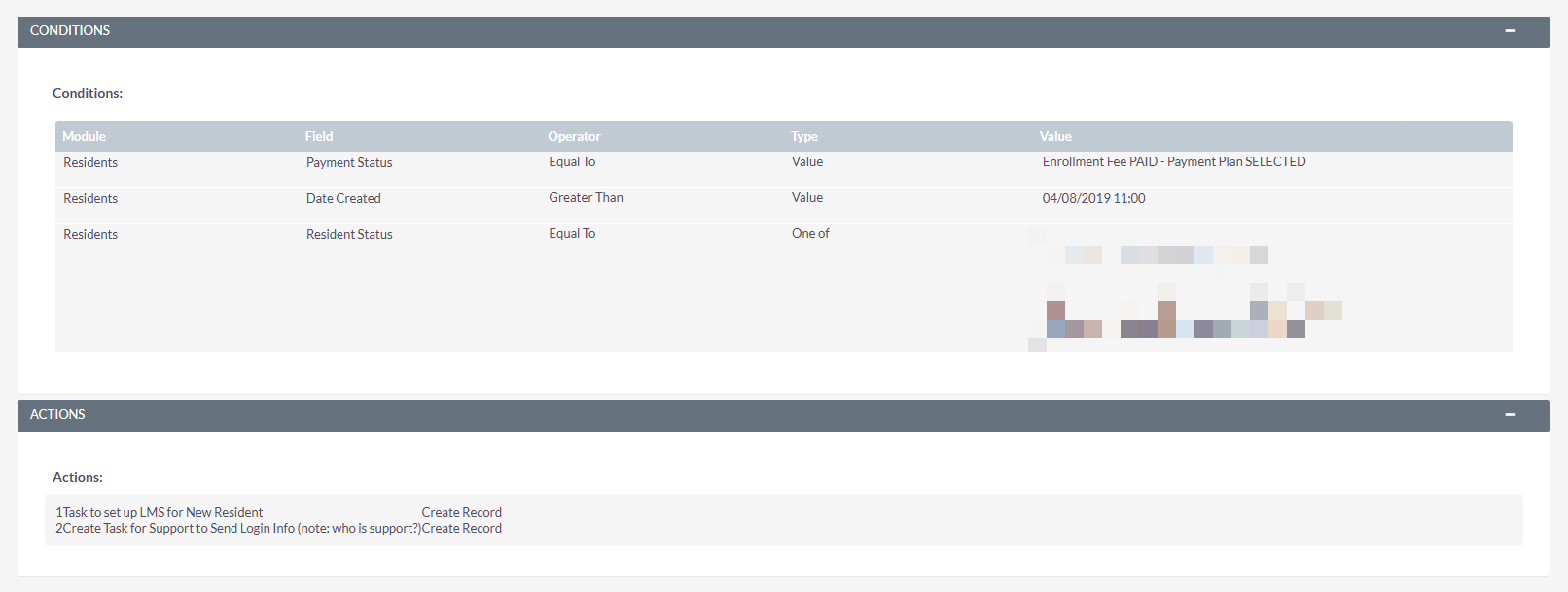
Stage 6: Enrollment & Academic Lifecycle
At this stage, the system evolves beyond a traditional CRM.
Each student record now includes:
- Assigned instructor (coach)
- Registered classes
- Course progress
- Completion status
- Evaluations and grades
Fully Connected Data Model
Relationships are maintained between:
- Students
- Instructors
- Classes
- Evaluations
This creates a complete academic record within a single system.
Here’s an example of a student record with course completion and contact history (blurred for confidentiality)
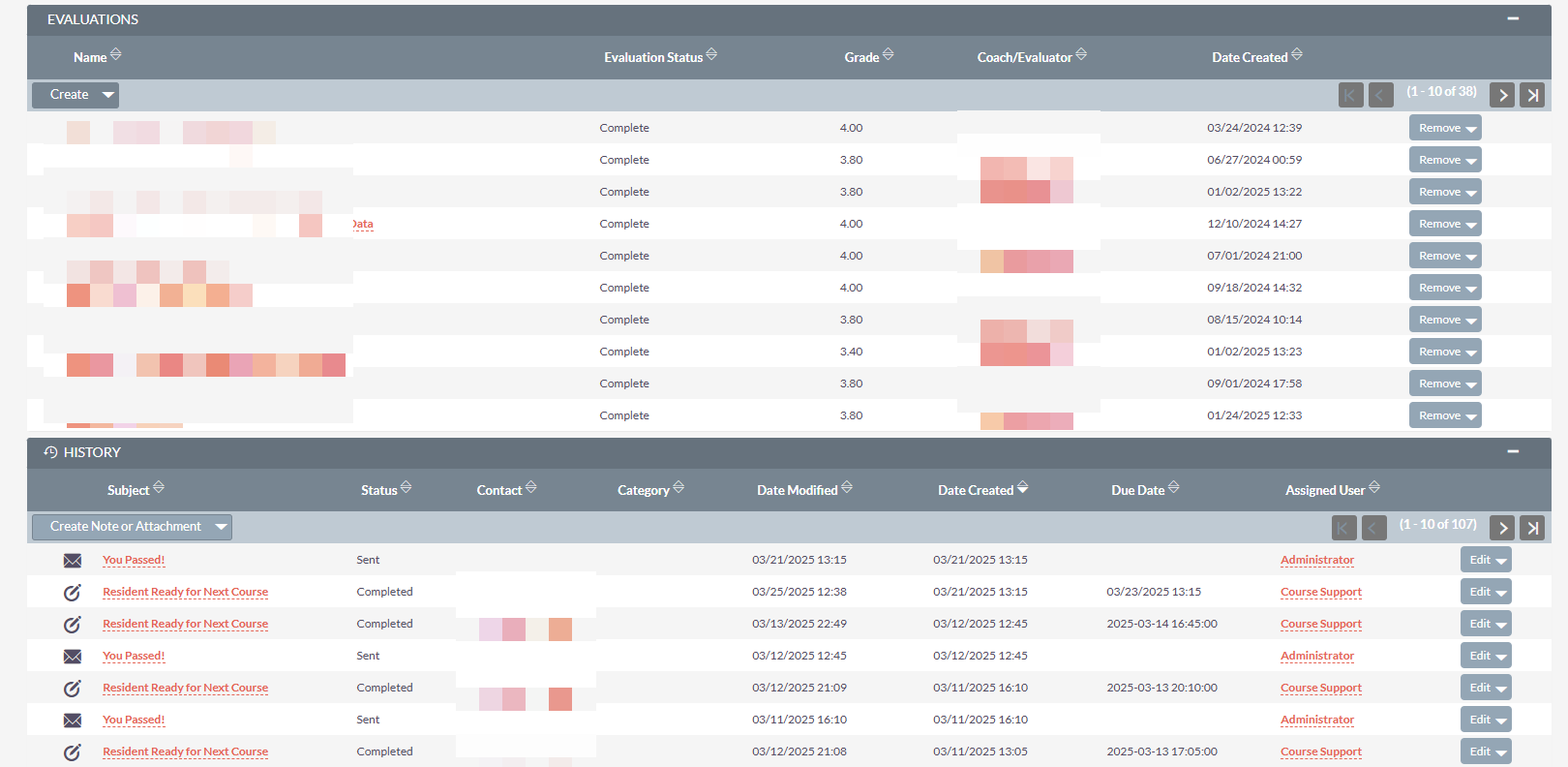
Multi-State Workflow Management
Institutions operating across multiple states often have:
- Slight variations in requirements
- Different compliance rules
- Unique process steps
Instead of duplicating systems, this approach supports:
- Shared core workflows
- State-specific variations
- Consistent user experience
The Outcome
Institutions implementing this approach gain:
- Reduced administrative workload
- Improved application completion rates
- Faster admissions processing
- Clear visibility across the entire lifecycle
- Better student experience
Why This Works
Most CRM implementations fail because they try to force a business into a predefined structure.
This approach succeeds because:
- It starts with the workflow
- It models real-world processes
- It adapts to institutional requirements
Final Thoughts
Admissions is not just about capturing leads — it’s about managing a complex journey that spans multiple stages, stakeholders, and requirements.
A properly designed system can:
- Automate the heavy lifting
- Ensure nothing falls through the cracks
- Provide full visibility from inquiry to graduation
And most importantly:
It allows admissions teams to focus on students — not spreadsheets.
Every institution has its own nuances, especially when operating across multiple regions or programs.
If you’re evaluating CRM solutions, the key question is not:
“Which system has the most features?”
But rather:
“Which system can be designed to match how we actually operate?”
That’s where the real value lies.
In practice, we implement this approach using SuiteCRM—an open-source, highly customizable platform that can be tailored to match complex admissions workflows without forcing institutions into rigid structures or per-seat licensing constraints. The technology matters, but the real advantage comes from how it is designed around your process.
Need help with SuiteCRM development?
I provide custom SuiteCRM development, customization, integrations, and technical support for businesses that need expert help.
