
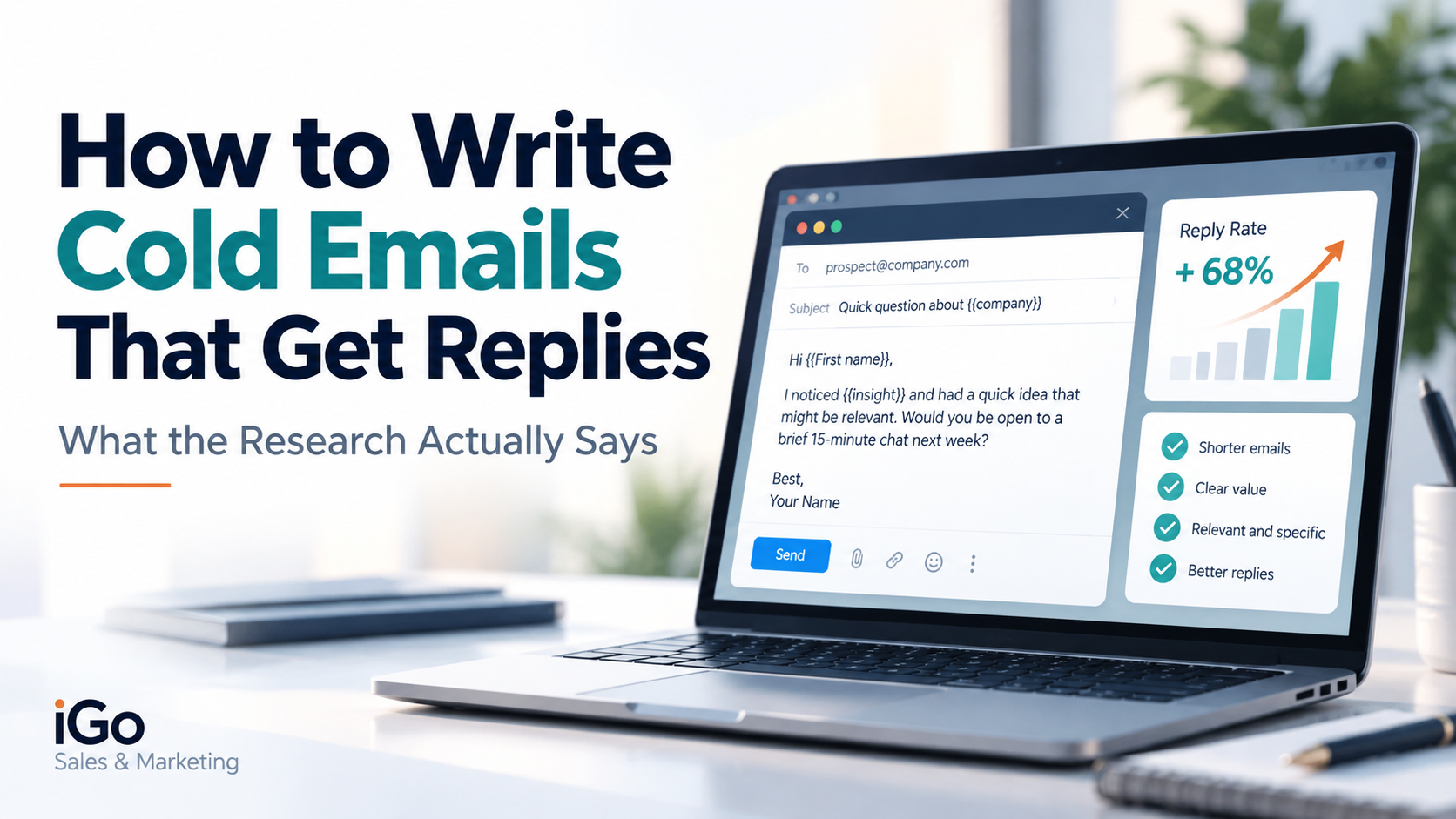
Shorter subject lines, fewer words, better personalization, and a simple call to action. Research involving millions of sales emails reveals what works—and what doesn’t.
Think about the last unsolicited sales email you received.
Was it a lengthy introduction to a company you’d never heard of? Did it contain several paragraphs about the sender’s products, a long list of benefits, perhaps a few impressive statistics, and an invitation to book a demonstration?
Did you read the whole thing?
Probably not.
Yet businesses continue to send these emails every day, believing that providing more information will improve their chances of making a sale.
The research suggests otherwise.
Sales engagement companies including Gong, Belkins, and Backlinko have analyzed millions of outreach emails to understand what makes recipients respond. While their findings aren’t always identical, several useful patterns emerge.
The most important is surprisingly simple: An introductory sales email shouldn’t try to make the sale. It should try to start a conversation.
Short subject lines generally perform better—but one word isn’t necessarily best
You may have heard that one-word email subject lines dramatically outperform longer alternatives.
There is some truth to the broader idea that shorter subject lines work well, but the evidence doesn’t support treating one word as a universal winner.
In a study of more than 85 million cold emails, Gong found that very short subject lines were associated with higher reply rates and recommended keeping them to fewer than four words.[1]
Belkins’ 2025 study, incorporating data from 5.5 million emails and its partnership with Reply.io, reached a more specific conclusion:
- 2–4-word subject lines: 46% average open rate
- One-word subject lines: 38% average open rate
- 10-word subject lines: 34% average open rate
In that dataset, two to four words performed better than either extreme.[2]
Interestingly, an earlier Backlinko and Pitchbox study of 12 million outreach emails found that subject lines of 36–50 characters performed best.[3] However, that research covered a broader category of outreach, including link-building and promotional campaigns.
The lesson isn’t to obsess over a particular word count. It’s to write a subject line that is brief, relevant, and natural.
Consider the difference:
Less effective: Discover Our Innovative Solutions to Improve Your Business Efficiency
Better: invoice processing delays
The second subject doesn’t try to sell anything. It identifies a topic that might matter to the recipient.
One caution: some subject-line studies measure email opens rather than actual replies or sales. Open rates can be distorted by automated email privacy protections, making them an imperfect indicator of genuine interest.
Keep introductory emails under 100 words
This may be the most useful finding for businesses accustomed to sending detailed sales presentations by email.
Gong’s analysis of 85 million cold emails found the following reply rates by message length:[1]
| Email length | Reply rate |
|---|---|
| Fewer than 50 words | 2.3% |
| 51–100 words | 2.6% |
| 101–150 words | 2.0% |
| 151–200 words | 1.6% |
Emails containing 51–100 words achieved a 62.5% higher observed reply rate than emails containing 151–200 words.
These are correlations, not proof that deleting words automatically increases replies. However, they provide a compelling reason to reconsider lengthy introductory emails.
Gong also found that emails containing three sentences achieved a 2.9% reply rate, compared with 1.9% for single-sentence messages. Four-sentence emails were close behind at 2.7%.[1]
The takeaway is that brevity matters, but so does providing enough context to be useful.
A practical structure is:
Personalization → Problem → Potential solution → Call to action
That is usually enough to establish why you’re contacting someone and give them a reason to respond.
Detailed product explanations, technical diagrams, company histories, and extensive service lists can wait until the prospect expresses interest.
Personalization should demonstrate relevance, not familiarity
Most salespeople understand that personalized emails perform better than generic messages.
Unfortunately, personalization is frequently reduced to inserting someone’s first name or mentioning their company.
Effective personalization goes further.
Gong’s research found that company-focused personalization performed particularly well when contacting director-level and more senior decision-makers. Messages addressing relevant company circumstances achieved approximately 9% reply rates, compared with a 2% baseline in its analysis.[1]
That is a substantial difference.
But the distinction is important.
Mentioning someone’s university or congratulating them on an anniversary may demonstrate that you’ve researched their LinkedIn profile. It doesn’t necessarily demonstrate that you understand their business.
A stronger approach is to reference something directly relevant to the product or service you’re offering.
For example:
I noticed your company recently announced plans to open two additional distribution centres. Expanding operations can make inventory visibility considerably more complicated.
This gives the recipient a reason to believe the message might be relevant.
Of course, the observation must be accurate. Invented familiarity, generic compliments, and unsubstantiated assumptions can undermine credibility rather than build it.
Personalization should answer one question: Why is this message relevant to this person, at this company, right now?
Stop selling your product. Start addressing the buyer’s problem.
Another recurring finding is that successful introductory messages focus on the recipient rather than the sender.
Gong found that top-performing sales representatives used prospect-focused language more frequently than their lower-performing peers. Its analysis also associated heavy use of sales buzzwords and product-focused language with weaker reply rates.[1]
Consider these two approaches.
Product-focused:
Our company provides an innovative, fully integrated platform featuring advanced automation, comprehensive reporting, and enterprise-grade functionality.
Problem-focused:
Are manual invoice approvals creating delays for your finance team?
The first describes a product.
The second introduces a potentially recognizable business problem.
That doesn’t mean product information is unimportant. Buyers eventually need to understand features, benefits, implementation, pricing, and return on investment.
But those discussions belong at the appropriate stage of the sales process.
An introductory email should establish relevance before attempting persuasion.
Ask for interest, not an immediate meeting
This finding may be counterintuitive for sales teams whose primary objective is booking appointments.
Gong analyzed 304,174 emails to determine which calls to action were associated with successful meeting bookings.
It found that asking whether a prospect was interested performed better than immediately requesting a meeting.[4]
Consider the difference.
High-commitment request:
Are you available for a 30-minute demonstration next Tuesday at 10 a.m.?
Low-commitment request:
Would it be useful if I shared a brief overview of how other businesses have addressed this problem?
The first requires the recipient to commit time to someone they don’t know.
The second simply asks whether the subject is worth exploring.
The distinction is particularly important when selling complex B2B products and services.
A prospect may be interested in learning something new without being ready to schedule a sales presentation.
Asking for interest first creates an opportunity to establish credibility and build toward a meaningful conversation.
Email works better as part of a broader prospecting strategy
Cold email should not necessarily operate in isolation.
In a separate analysis involving more than 300 million cold calls, Gong found that sales outreach incorporating telephone activity was associated with higher email reply rates.
The reported rates were 3.44% when calling activity was involved, compared with 1.81% without it.[5]
That doesn’t prove that making a phone call directly caused the improvement. Sales representatives who use multiple channels may also differ in prospect selection, persistence, and other important ways.
Nevertheless, it supports a practical business development approach.
Rather than immediately sending hundreds of identical emails, identify a smaller number of well-qualified prospects, research their needs, and engage them through appropriate channels.
A relevant telephone conversation can reveal far more about a prospective customer’s needs than an unopened email.
Follow-up emails can then address specific questions, objections, or interests rather than repeating the original sales pitch.
The objective should be to develop qualified sales conversations—not simply maximize the number of messages sent.
Sending more emails doesn’t guarantee more business
One of the most sobering findings comes from Belkins’ June 2026 research.
The company analyzed 7.5 million cold emails sent during 2025 and reported an average reply rate of just 0.45% of total emails sent.[6]
At that rate, sending 1,000 emails would generate approximately four or five replies.
And a reply is not necessarily a positive response, a qualified sales opportunity, or a sale.
Importantly, Belkins changed its measurement methodology for this report. Previous studies calculated replies against recipients who opened messages; the 2026 study divided replies by total emails sent. Consequently, its figures shouldn’t be compared directly with older studies using different denominators.
Still, the findings reinforce a critical lesson.
A large contact database is not the same thing as a qualified sales pipeline.
A company might have access to 1,000 relevant business contacts, but that doesn’t mean all 1,000 should immediately receive the same sales email.
There is often more value in identifying 25 highly relevant prospects, understanding their circumstances, and developing a thoughtful approach than in sending a generic message to everyone in the database.
High-volume emailing can also introduce deliverability risks. Google’s email sender guidelines recommend keeping user-reported spam rates below 0.1% and avoiding rates of 0.3% or higher.[7]
Simply increasing volume can become counterproductive if recipients begin marking unwanted messages as spam.
What does a research-informed introductory email look like?
Here’s an example for a business offering accounts payable automation software.
Subject: invoice approval delays
Hi Sarah,
I saw that [Company] recently announced an expansion into two new markets.
As businesses grow, managing invoice approvals across locations can become increasingly complicated.
We help finance teams simplify approvals and reduce manual processing.
Would it be useful if I shared a brief checklist for identifying opportunities to streamline the process?
John
Example only. The reference to company expansion should be used only when verified. Include the necessary sender identification and unsubscribe information for the applicable jurisdiction.
Notice what’s missing.
There is no company history, lengthy product description, impressive list of features, or demand for a 30-minute meeting.
Instead, the email has a relevant opening, identifies a plausible challenge, briefly describes how the sender might help, and offers a low-commitment next step.
It does not attempt to close the sale.
It attempts to earn a reply.
Measure conversations, not just email activity
Many businesses measure outbound prospecting by the number of emails sent, open rates, click-through rates, and campaign volume.
Those metrics can be useful operational indicators, but they don’t necessarily demonstrate that sales activity is working.
A more meaningful assessment looks at positive responses, qualified conversations, appointments, opportunities created, and ultimately revenue generated.
For example, a campaign that generates 50 replies but no qualified opportunities may be less valuable than one that generates five replies from organizations actively evaluating a purchase.
Businesses should also distinguish between an email being opened, receiving a response, and generating genuine buying interest.
Google itself notes that it cannot verify the accuracy of open-rate figures reported by third parties.[7]
The ultimate objective of prospecting isn’t to generate impressive email statistics. It’s to create profitable customer relationships.
The bottom line: Sell the conversation before selling the solution
The research doesn’t provide a magical formula that guarantees replies.
Different audiences, industries, offers, and market conditions will produce different results. Most of the studies discussed here are observational analyses conducted by sales technology providers, not randomized experiments.
Nevertheless, the findings provide a useful framework.
Keep subject lines short and relevant. Aim for fewer than 100 words. Personalize around actual business circumstances. Address one recognizable problem. Ask a simple question rather than demanding an appointment. And use email as one component of a broader, targeted business development strategy.
Most importantly, resist the temptation to put everything you know about your company into the first email.
The purpose of an introductory sales email isn’t to prove how much you know. It’s to give the recipient a compelling reason to want to know more.
That conversation is where the real selling begins.
Important legal note: Canada and the United States
Canada (CASL): Canada’s Anti-Spam Legislation generally requires prior express consent or legally valid implied consent before sending commercial electronic messages, unless a specific exemption applies. Messages subject to CASL must also satisfy sender identification and unsubscribe requirements. Purchasing a contact list or obtaining email addresses through prospecting software does not automatically establish consent. Certain business relationships and relevant, conspicuously published business addresses may qualify under specific conditions. Organizations should verify and document their legal basis before sending commercial outreach.[8]
United States (CAN-SPAM): U.S. federal law generally allows unsolicited commercial B2B email provided the sender complies with applicable requirements, including truthful identifying information, non-deceptive subject lines, a valid postal address, appropriate advertising identification, and an effective unsubscribe mechanism.[9]
Research sources and footnotes
[1] Gong and 30 Minutes to President’s Club. How to Master Cold Email: A Data-Backed Guide Based on 85 Million Emails. Sections on subject lines, message length, personalization, and calls to action. Read the research (PDF).
[2] Belkins (August 2025). How Different B2B Cold Email Subject Lines Perform: Belkins’ 2025 Study. Analysis incorporating 5.5 million emails and partner data. Read the study.
[3] Backlinko and Pitchbox (2019). We Analyzed 12 Million Outreach Emails. Here’s What We Learned. Analysis of response rates, subject lines, personalization, and follow-ups. Read the study.
[4] Gong. Before You Hit Send: 7 Sales Email Statistics to Boost Your Email Game. Includes analysis of calls to action in 304,174 emails. Read the findings.
[5] Gong (July 2024; subsequently updated). The Hidden Power of Cold Calling: Insights from 300M Calls. Examines calling performance and its association with email replies. Read the research.
[6] Belkins (June 2026). What Are B2B Cold Email Response Rates? Belkins’ 2026 Study. Analysis of 7.5 million emails sent in 2025, including its revised reply-rate methodology. Read the study.
[7] Google. Email Sender Guidelines. Official recommendations on spam rates, sender authentication, deliverability and email measurement. Read Google’s guidelines.
[8] Canadian Radio-television and Telecommunications Commission (CRTC). Canada’s Anti-Spam Legislation: Guidance on Implied Consent. Official guidance on consent, business relationships and conspicuously published electronic addresses. Read CRTC guidance.
[9] U.S. Federal Trade Commission (FTC). CAN-SPAM Act: A Compliance Guide for Business. Official requirements for commercial email, including business-to-business messages. Read FTC guidance.
Research note: All statistics reflect the cited datasets and methodologies. Results may differ by market, industry, audience, and campaign. Observational findings should not be interpreted as guarantees of performance.