


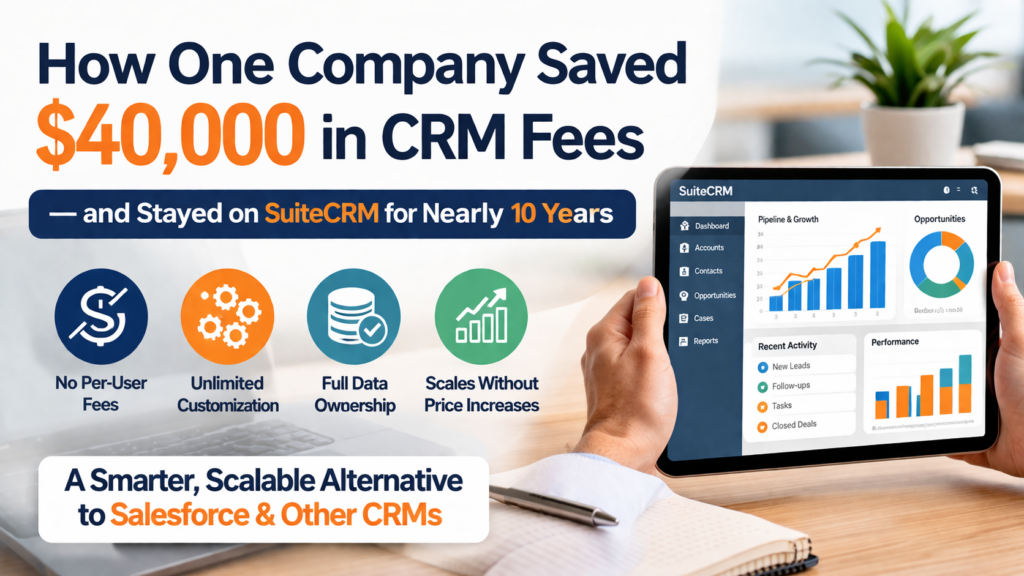
CRM software can become surprisingly expensive as a business grows.
What starts as a manageable monthly subscription can quickly turn into a major operating expense once you begin adding users, custom fields, workflows, automation, and reporting. For many growing businesses, the problem is not just the base subscription cost — it is the constant pressure of pricing tiers, feature limits, and add-on fees.
Several years ago, I helped a client migrate from Salesforce to SuiteCRM, an open source CRM platform. At the time, the move saved them roughly $40,000 per year in CRM software fees.
That would have been a good success story on its own.
But here is the part that matters even more today:
They are still using SuiteCRM nearly 10 years later.
That kind of longevity says a lot. This was not a short-term experiment or a risky cost-cutting move that had to be reversed later. It was a practical business decision that delivered immediate savings and long-term value.
The Problem with Per-User CRM Pricing
Many commercial CRM platforms are designed in a way that makes growth more expensive.
As your business expands, you may need:
- more users
- more automation
- more customization
- more workflows
- more reporting
- more integration flexibility
Unfortunately, in many paid CRM platforms, those needs often trigger higher pricing tiers, additional licensing costs, or feature restrictions.
In this client’s case, they had roughly a dozen users and relied on a growing number of custom fields and workflows. As their requirements expanded, their CRM costs continued to rise. The annual cost reached roughly $40,000 per year — and there was every reason to believe it would continue climbing as the company grew.
That is the trap many businesses fall into:
The CRM that was supposed to support growth starts penalizing growth.
Why SuiteCRM Made Sense
I recommended moving them to SuiteCRM, an open source CRM that can be hosted on your own server or cloud VPS.
The appeal was straightforward:
- no per-user licensing fees
- no artificial limits on users
- no extra charges for adding fields or workflows
- full ownership of the system and the data
- flexibility to customize the CRM around the business, instead of forcing the business to adapt to the software
Instead of continuing to pay escalating subscription fees, the client made a one-time investment in migration, implementation, and training.
The result was immediate cost savings and a much more scalable long-term setup.
What the Migration Included
The migration project included:
- moving the data from Salesforce into SuiteCRM
- configuring the system for the client’s business needs
- training both users and administrators
- setting them up with an affordable hosting environment
- ensuring they could manage the system without being dependent on large ongoing platform fees
At the time, the implementation cost was only a fraction of a single year of their existing CRM fees. Hosting costs were minimal compared to what they had been paying in annual licensing.
That is why open source CRM can be so compelling for the right business.
The economics change dramatically when you stop paying recurring fees simply for the right to keep using your own customer data.
The Part People Need to Understand
Open source is not magic, and it is not the perfect fit for every company.
There is a tradeoff.
When you move to a self-hosted CRM, you gain flexibility, ownership, and cost control — but you also take on more responsibility. Someone needs to handle:
- backups
- updates
- security
- user support
- general system administration
For this client, that was not a problem. They had internal IT capability, and their support requirements were relatively modest.
That is an important point:
SuiteCRM is often a great fit for businesses that want more control and either have internal technical capability or a trusted partner to support the system.
If your company expects a vendor-managed, fully hands-off SaaS experience with a support hotline bundled into the subscription, then a self-hosted CRM may not be the right model.
But if you are tired of paying more every time your team grows or your process becomes more sophisticated, the tradeoff can be well worth it.
Open Source vs. Saas CRM Model
| Factor | Self-Hosted Open Source CRM | SaaS CRM Model |
|---|---|---|
| Licensing | No per-user license fees | Usually priced per user, per month |
| Customization | High flexibility, no vendor tier limits | Often limited by plan level or add-ons |
| Data Ownership | Greater control over hosting and data | Data lives in vendor-controlled environment |
| Cost as You Grow | More predictable infrastructure/support costs | Costs often rise with users, features, storage, and automation |
| Upfront Investment | Higher setup and implementation effort | Lower initial setup barrier |
| Ongoing Support | Handled internally or through a partner | Typically included in subscription |
| Updates & Maintenance | Your team or partner manages them | Vendor-managed |
| Scalability | Scales without per-seat penalties | Growth often increases subscription cost |
| Best Fit For | Companies wanting control, flexibility, and lower long-term cost | Companies wanting convenience and fully managed infrastructure |
Why This Story Still Matters in 2026
This story is even more relevant today than it was when I first wrote about it.
CRM costs have not gotten simpler. In many cases, they have become harder to predict. Businesses are now evaluating not just user licenses and add-ons, but also:
- automation limits
- reporting tiers
- integration costs
- storage costs
- premium support costs
- AI feature add-ons
Companies are realizing that they do not just need a CRM.
They need a CRM strategy that is sustainable.
That means asking better questions:
- What will this platform cost when we double in size?
- Are we paying extra every time we improve our process?
- Do we really control our own data and customization roadmap?
- Are we building on a platform we own, or renting access to one that becomes more expensive every year?
For the right organization, SuiteCRM is a very strong answer to those questions.
What Else SuiteCRM Can Do
One of the reasons SuiteCRM is so attractive is that it offers much more than basic contact and opportunity management.
Depending on your needs, SuiteCRM can also support:
- customer service and case management
- workflow automation
- project management
- quote and invoice processes
- campaign management
- custom modules and tailored business processes
- dashboards and reporting
- deeper integrations with other business systems
In other words, it can serve not just as a contact database, but as a true business operations platform.
The Real Lesson
The biggest lesson from this project is not simply that one company saved $40,000 per year.
It is that they made a strategic technology decision that continued paying off for nearly a decade.
That is what businesses should be looking for:
- lower total cost of ownership
- more control
- better fit to their process
- room to grow without being punished for growth
Sometimes the most expensive CRM is not the one with the highest monthly fee.
It is the one that becomes harder and more expensive to live with every year.
Is SuiteCRM Right for You?
SuiteCRM is not the right fit for every business.
But if you are currently evaluating Salesforce, HubSpot, or another commercial CRM — or if you are dreading another renewal conversation because of rising license costs — it may be worth looking at whether an open source CRM model makes more sense.
If you want a second opinion on your CRM costs, migration options, or long-term CRM strategy, I’d be happy to talk.