


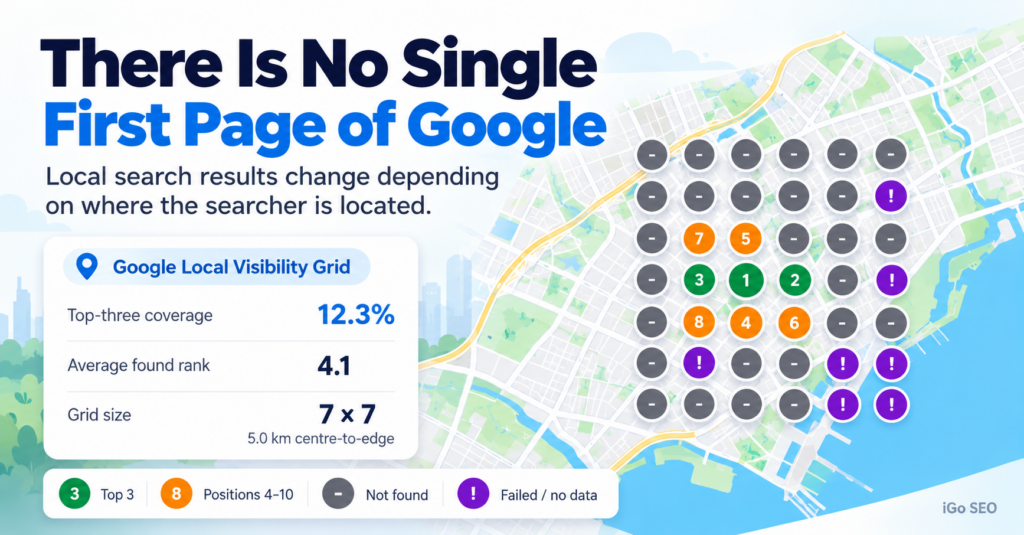
Why your Google Maps ranking depends on where your customers are searching — and how to measure it.
For years, businesses have asked the same question about their websites:
“Are we on the first page of Google?”
The problem is that there isn’t one first page of Google. What you see when you search can be quite different from what your potential customers see.
And for local businesses, those differences can be dramatic.
Google search is changing
Google’s search results look very different than they did just a few years ago.
AI-generated summaries, featured results, videos and other search features are increasingly competing for space with the traditional blue website links.
On searches where Google’s AI Overviews appear, those familiar organic listings can be pushed further down the page.
But there’s one part of Google Search that remains especially important for businesses serving local customers: Google Maps and the local business listings.
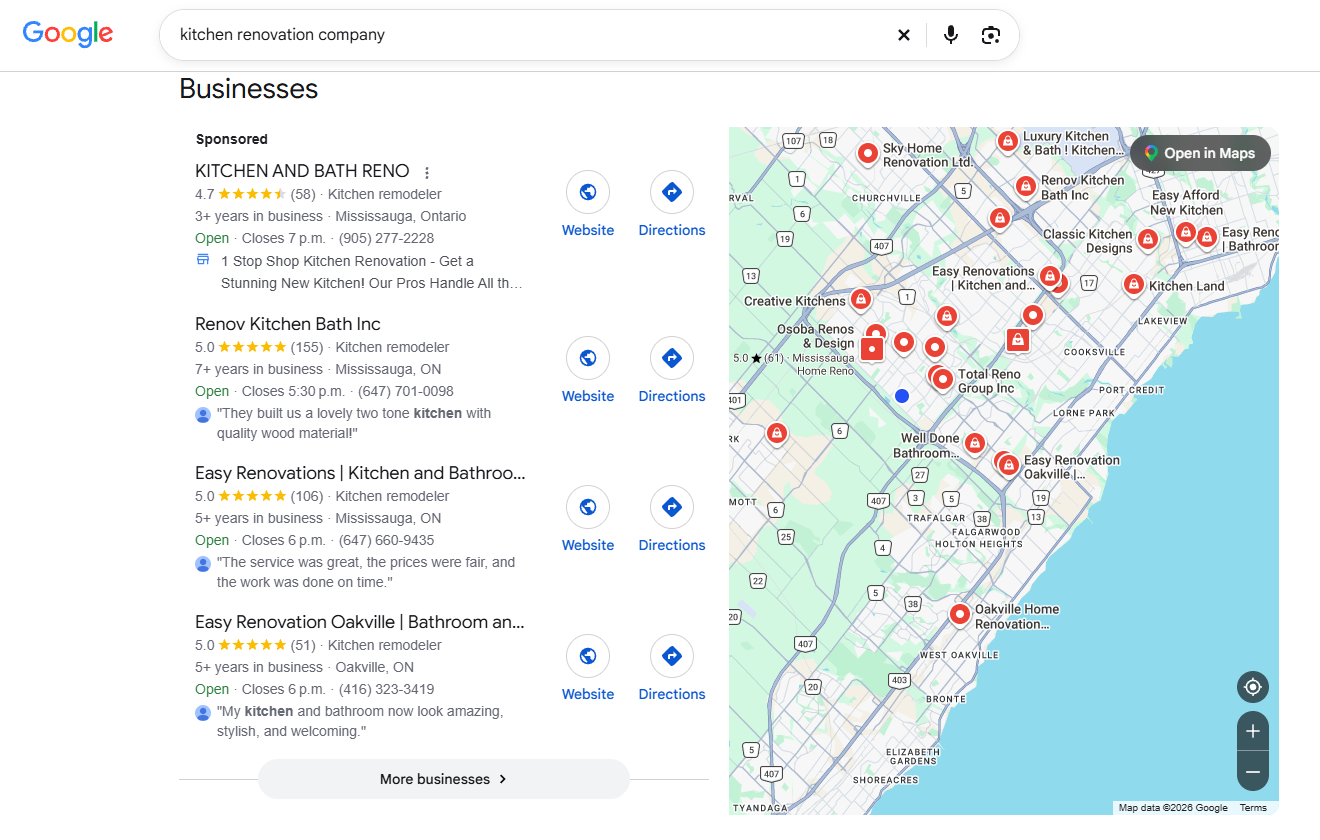
Search for “kitchen renovation company,” “commercial electrician” or “accountant near me,” and Google may prominently display a map with three local businesses.
For many local service providers, appearing in those results is a valuable opportunity to be discovered by potential customers.
Your location changes what Google shows you
Here’s what many business owners don’t realize.
Someone searching for a kitchen renovation company in central Mississauga may see three completely different businesses than someone conducting the same search in Oakville or Etobicoke.
Even within the same city, the results can change significantly from one neighbourhood to another.
Google considers several factors when deciding which local businesses to display, including:
- Relevance: How closely your business matches the search.
- Distance: How far your business is from the searcher’s location.
- Prominence: How established and recognized your business is, including factors such as reviews and information found across the web.
So, when someone tells you your business ranks number one on Google, the natural next question should be:
“Number one where?”
Introducing the Google Local Visibility Grid
To help answer that question, we’ve built a geographic ranking tool into our iGo SEO platform.
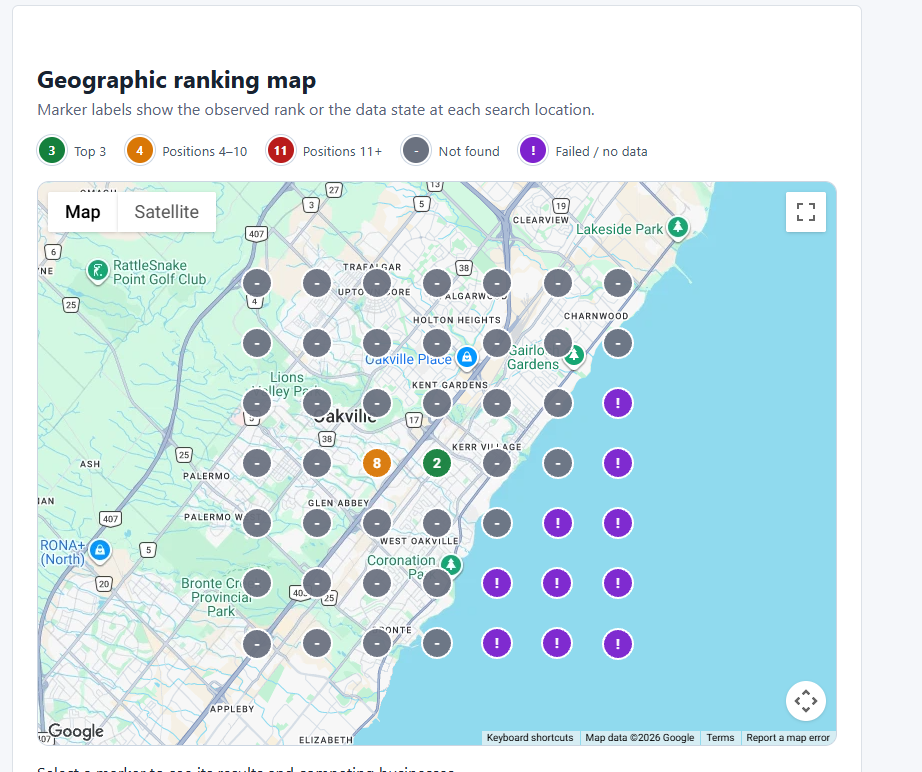
Rather than checking a business’s Google Maps ranking from a single location, our tool measures its visibility across a grid of geographic points covering its service area.
Each point represents a search conducted from a different location for the same keyword.
The resulting map makes it easy to see where a business appears in the top three local results, where it ranks lower, and where it doesn’t appear in the results measured.
Instead of a single ranking number, we get a geographic picture of how visible the business is to potential customers.
Measuring the results of local SEO
Most importantly, this gives us a baseline. Before beginning a local SEO improvement campaign, we can measure where the business currently appears in Google Maps.
From there, we can work on the factors that may be limiting its visibility:
- Google Business Profile: Correct categories, services, business information, photos and reviews.
- Website optimization: Clearly explaining what the business does, where it operates and which communities it serves.
- Local business citations: Correcting inconsistent names, addresses, phone numbers and business information across relevant directories.
- Local relevance and authority: Building a stronger, consistent online presence that reinforces the business’s services and geographic relevance.
We can then repeat the same geographic scan to see whether visibility is improving, and where further work may be needed.
Of course, no amount of optimization guarantees a top-three ranking everywhere. Distance and competition will always influence the results.
But we can stop guessing and start measuring.
The real question isn’t whether you’re on page one
It’s whether potential customers can find your business when they’re looking for the services you offer, in the communities you serve.
As Google continues to evolve, understanding and measuring your local search visibility is becoming increasingly important.
Want to know how visible your business really is on Google Maps?
Contact iGo Sales and Marketing to learn about your free Local Visibility Baseline Report.