
How many emails, phone calls, and follow-ups does it really take to win a new customer? The numbers might surprise you. But the good news is that you have more control over the results than you might think.
You’ve sent a dozen sales emails. Nobody responded.
You made a few cold calls. Everyone went to voicemail.
You posted something on LinkedIn. A few people liked it, but nobody called.
Maybe you conclude that cold calling doesn’t work anymore. Email marketing is dead. Or perhaps you need to spend more money driving traffic to your website.
Before you give up on outbound sales, consider something: You might not have done nearly enough to know whether your approach works.
And there’s another possibility. You might be contacting the wrong people, with the wrong message, at the wrong time.
Let’s look at some actual B2B sales statistics and, more importantly, what you can do to improve your odds.
The Numbers: B2B Sales Isn’t for the Impatient
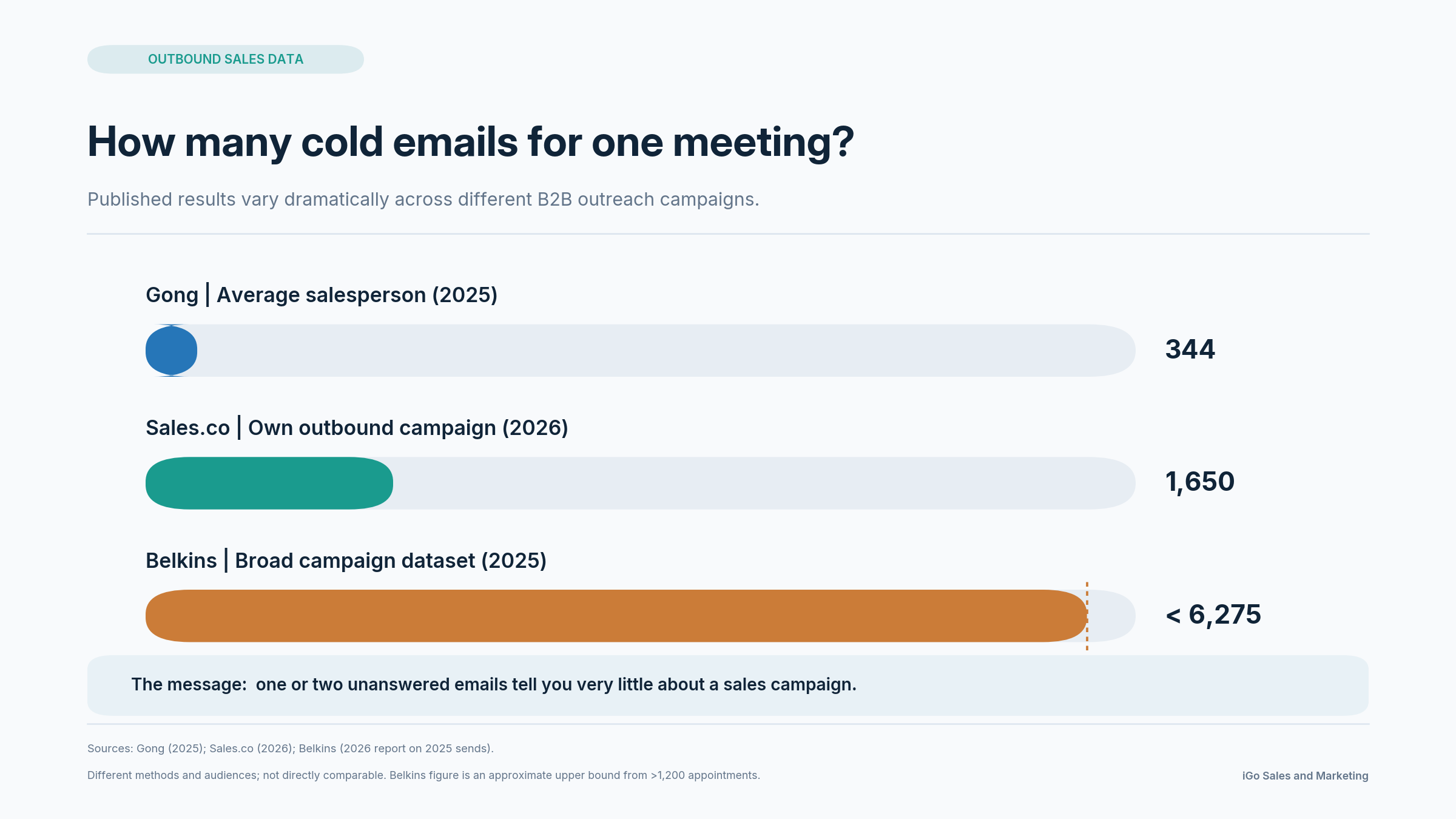
In 2025, sales intelligence company Gong analyzed more than 28 million cold emails.
Their findings included a sobering statistic:
The average salesperson needed to send 344 cold emails to book a single meeting.
That’s 344 emails. Not to close a sale. Not to deliver a proposal. Just to get someone to agree to a conversation.
And Gong’s research found that top-performing salespeople booked 8.1 times as many meetings as average performers.
Source: Gong, Does Cold Email Even Work Anymore?
Another study, published by Belkins in 2026, examined more than 7.5 million cold emails sent during 2025.
The results were even more challenging:
- 7,530,489 emails sent.
- 34,393 human replies recorded.
- An average reply rate of just 0.45%.
- More than 1,200 appointments booked.
Based on those reported figures, the campaign generated approximately one appointment for every several thousand emails sent. Dividing the total volume by 1,200 appointments produces roughly 6,275 emails per appointment, although the exact figure is lower because Belkins reported more than 1,200 appointments.
Source: Belkins, B2B Cold Email Response Rates, 2026
Now, these two studies aren’t directly comparable. They involve different audiences, sales organizations, outreach strategies, and methods of measuring results.
But they demonstrate something important.
Getting a meeting with a stranger is difficult. Getting that stranger to become a customer is even harder.
And that’s before you consider proposals, negotiations, competition, budgets, and all the other things that can prevent a deal from closing.
What About Cold Calling?
Surely picking up the phone improves your chances?
It can. But the numbers are challenging here, too.
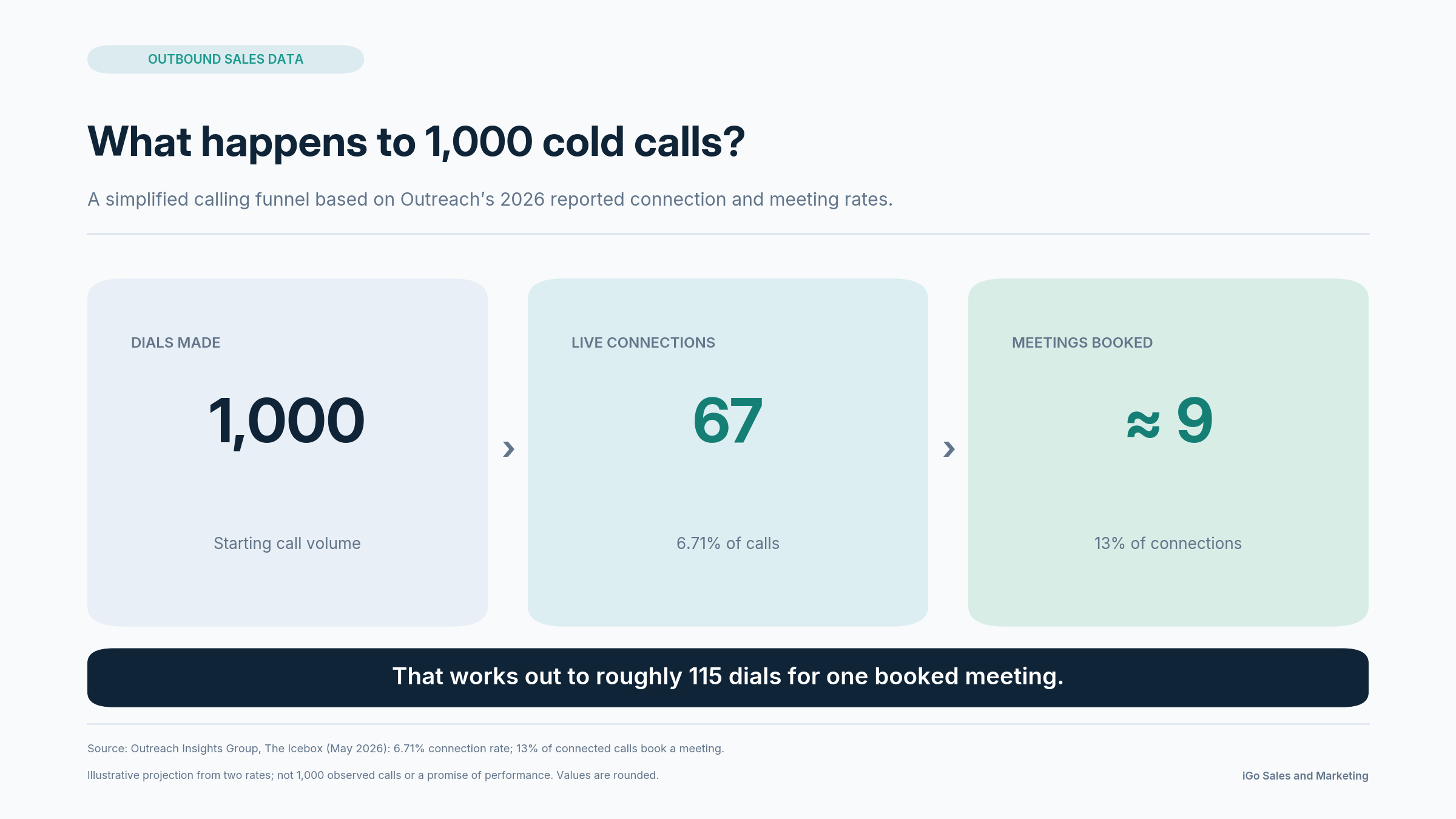
According to Outreach’s 2026 cold outreach research:
- The average cold-call connection rate was 6.71%.
- Of those connected calls, 13% converted into meetings.
Do the arithmetic, and those figures suggest approximately 15 calls to connect with someone and around 115 dials to generate one meeting, assuming those averages apply consistently.
That’s not a universal benchmark. Some teams perform much better, while others perform considerably worse.
Source: Outreach, The Icebox: Cold Outreach Statistics for 2026
The important point is that even experienced salespeople encounter far more unanswered calls, unreturned messages, and unsuccessful conversations than they do opportunities.
A salesperson can make 20 calls and accomplish absolutely nothing that day.
That doesn’t necessarily mean they’re doing a poor job.
But making five calls, sending three emails, and expecting a steady stream of new customers isn’t a realistic sales strategy either.
Persistence Matters More Than You Think
One of the biggest mistakes in B2B prospecting is treating the first unanswered message as the end of the conversation.
Outreach’s 2026 research found that it took an average of:
- 4.8 touches to receive a first response.
- 7.4 touches to book a meeting.
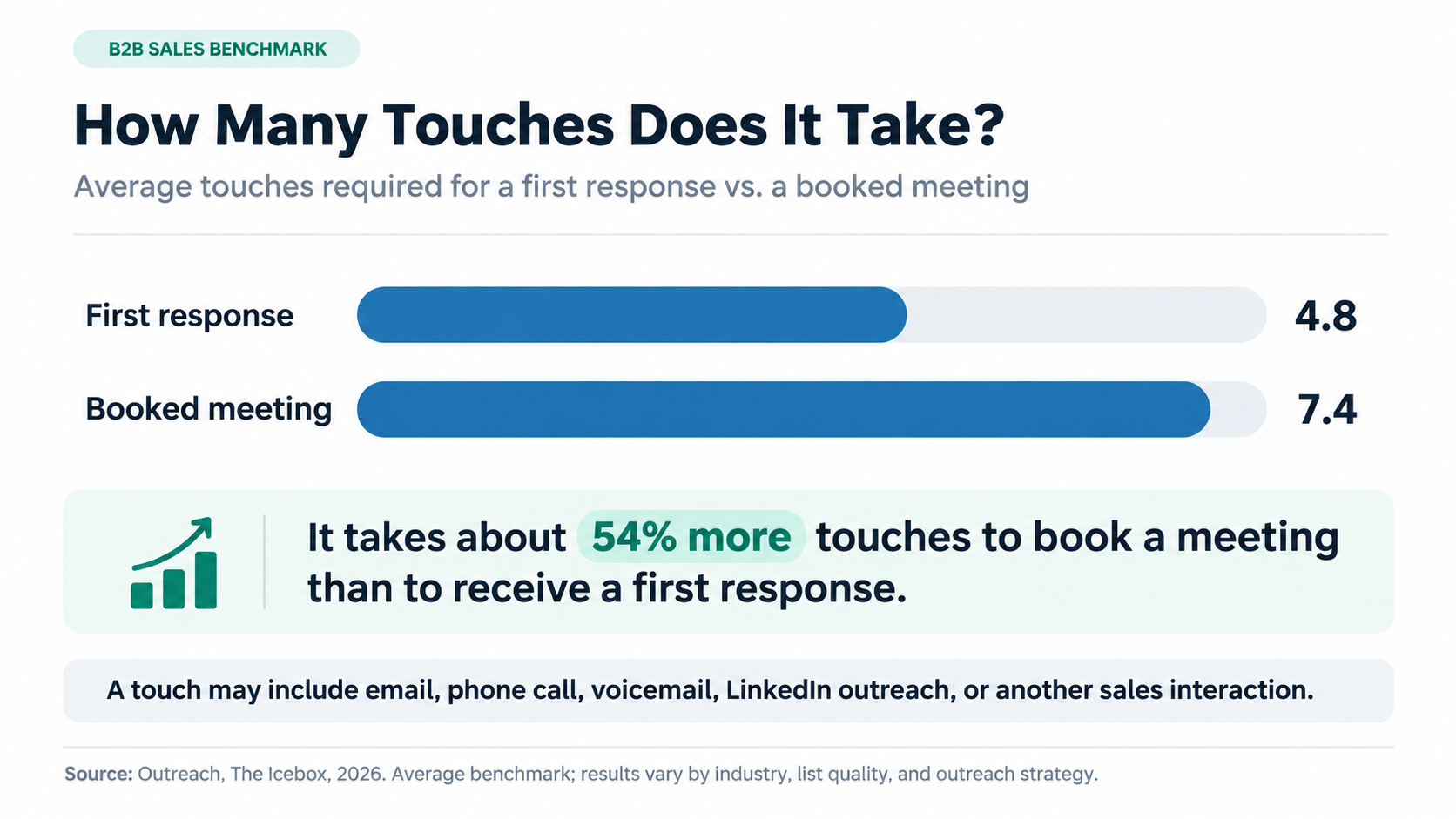
A touch might be an email, phone call, LinkedIn interaction, or another attempt to engage a prospect.
Belkins found that 58.6% of email replies came from follow-up messages rather than the initial email. More than half of email-sourced meetings were attributed to the third through fifth steps of an email sequence.
Source: Belkins, Sales Follow-Up Statistics, 2026
Think about that.
Many potential conversations never happen because the salesperson simply stops trying.
But there’s an important distinction between professional persistence and repeatedly bothering someone who has no interest in your offer.
A good follow-up should add something useful: a different perspective, a relevant example, an insight, or a reason why the conversation might be worthwhile.
Sending the same message five times isn’t persistence. It’s repetition.
And repetition without relevance can quickly become irritating.
The Problem With Simply Sending More Emails
At this point, you might conclude that sales is purely a volume game.
If 344 emails generate one meeting, send 3,440 and get ten meetings.
If 100 calls aren’t enough, make 1,000.
Unfortunately, it doesn’t work quite that neatly.
Research from Hunter’s 2026 State of Email Outreach report, based on 31 million emails, found an interesting difference between narrowly targeted campaigns and large-volume outreach:
| Campaign size | Average reply rate |
|---|---|
| 21–50 recipients | 6.2% |
| 500+ recipients | 2.4% |
The smaller, more targeted campaigns generated more than 2.5 times the reply rate.
Source: Hunter, State of Email Outreach 2026
That doesn’t prove that smaller campaigns always outperform larger ones. But it strongly suggests that targeting and relevance matter.
And there’s another finding that every sales and marketing professional should consider.
A Gartner survey of 632 B2B buyers found that 73% actively avoid suppliers who send irrelevant outreach.
Source: Gartner, B2B Buyer Preferences, June 2025
In other words, bad prospecting doesn’t simply waste your time.
It can actively damage your chances of doing business with someone in the future.
So how do you improve your odds?
After years of working in sales, sales management, CRM, and marketing, I keep coming back to four fundamental principles.
They aren’t particularly complicated. But they require thought, preparation, and consistent execution.
Know Your Customer
This sounds obvious, but it’s surprising how many businesses begin prospecting without a clear understanding of whom they should actually be contacting.
Knowing your customer’s industry, company size, and job title is a starting point.
You need to go further.
What are they responsible for?
What problems are they trying to solve?
How is their performance measured?
What happens when something goes wrong?
What circumstances might make them consider changing suppliers?
For example, a Chief Financial Officer might care about predictable costs, cash flow, and financial risk.
An Operations Manager might be far more concerned about productivity, delays, service levels, and keeping customers happy.
An IT executive might be evaluating cybersecurity exposure, reliability, operational disruption, and the resources required to support increasingly complex systems.
All three executives could work for the same company, but their reasons for purchasing your product or service might be completely different.
The better you understand your ideal customer, the more effectively you can prioritize your sales activities.
Modern prospecting tools can help identify companies based on industry, size, technology, growth, hiring activity, and possible purchasing signals.
But remember that a buying-intent signal is an indication of possible interest, not proof that someone is ready to buy.
Use that information to prioritize your research and identify people worth contacting.
Don’t confuse having a large contact database with having a good prospect list.
Speak Your Customer’s Language
Here’s an exercise.
Look at the last sales email you sent.
How much of it talks about your company, your services, your technology, and your capabilities?
Now ask yourself how much of it talks about the customer’s business.
Salespeople often become so familiar with their products that they forget their prospects don’t necessarily understand—or care about—the terminology.
Consider a business software provider.
They might describe their solution as:
“We offer a comprehensive, integrated, cloud-based enterprise platform with advanced workflow automation and real-time analytics.”
That sounds impressive.
But consider this alternative:
“How much time does your team spend entering the same customer information into different systems? We help businesses eliminate duplicate work and give managers a clearer picture of what’s happening.”
The second message describes a problem the prospect might recognize.
It gives them something to think about.
It’s relevant to their working day.
The same principle applies whether you’re selling technology, consulting, manufacturing equipment, logistics, or professional services.
Gong’s cold-email research found that leading with product pitches could reduce reply rates by as much as 57%.
Their recommendation was to use language reflecting the buyer’s priorities and problems rather than relying on product features and industry buzzwords.
Your prospects don’t buy your technical specifications. They buy the business outcomes those specifications make possible.
Speak about those outcomes.
Demonstrate That You Understand Their Problem
There’s a difference between knowing what your customer does and demonstrating that you understand what they’re dealing with.
Let’s say you’re selling services to manufacturing companies.
You could begin with a presentation about your company’s history, capabilities, staff, technology, and awards.
Or you could start by asking:
“When equipment goes down unexpectedly, how does that affect your production schedule and your ability to meet customer commitments?”
That’s a very different conversation.
You’re no longer trying to convince someone that your company is impressive.
You’re trying to understand whether there’s a problem you can help solve.
This is where experience, industry knowledge, and preparation become valuable.
You don’t need to know everything about a prospect’s business before the first conversation.
In fact, pretending you already know their problems can work against you.
Instead, demonstrate that you understand the challenges businesses like theirs commonly face.
Ask intelligent questions.
Listen to their answers.
And be prepared to discover that the problem you expected isn’t actually their biggest concern.
A good sales conversation should feel less like a presentation and more like a productive discussion between two professionals.
Before people trust your solution, they need confidence that you understand their problem.
Offer Simple Solutions and Clear Next Steps
Imagine you’ve successfully reached a prospect.
They’re interested enough to listen.
Now what?
Too often, salespeople immediately overwhelm them with information.
They explain every feature, every option, every product variation, and every reason their company is better than the competition.
But at this stage, the prospect may simply be trying to answer a few basic questions:
- Can this company help me?
- Do they understand my situation?
- Will working with them be difficult?
- What happens next?
Make those answers easy.
Don’t immediately try to sell the entire solution.
Offer a manageable next step.
Perhaps it’s a brief assessment of their current situation.
Perhaps it’s a relevant case study.
Perhaps it’s a demonstration focused on one particular problem.
Perhaps it’s simply a 15-minute conversation to determine whether there’s a good fit.
Gong’s research also found that shorter cold emails perform better, with strong results from messages of 100 words or fewer.
That makes sense.
Busy people don’t want to spend five minutes deciphering a sales pitch from someone they’ve never met.
They want to understand why you’re contacting them and what you’re suggesting.
Make the next step easy to understand, easy to evaluate, and easy to accept.
Combine the Right Message With the Right Follow-Up
Once you have a carefully selected prospect and a relevant message, you still need a process for consistently reaching them.
This is where a coordinated, multichannel prospecting strategy makes sense.
Instead of relying entirely on email, consider a sequence involving:
- An introductory email focused on a relevant business problem.
- A personalized LinkedIn connection request.
- A telephone call, with a brief voicemail where appropriate.
- A follow-up email offering another perspective or useful information.
- Another telephone attempt.
- A relevant case study, insight, or resource.
- A final, professional follow-up offering a clear next step.
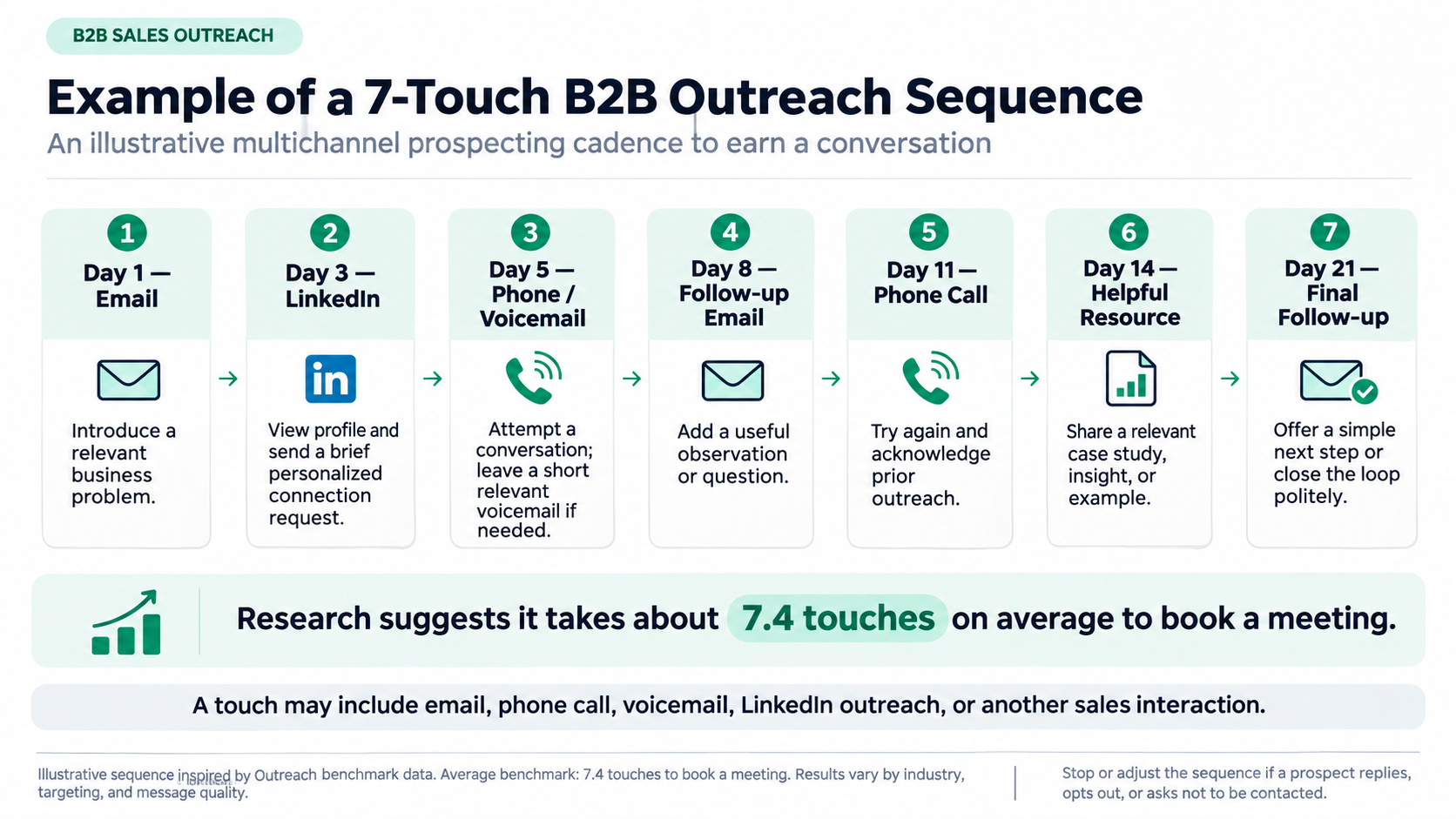
The exact sequence and timing should depend on the audience, the offer, and applicable communication rules. Stop when someone declines further contact.
Research from Outreach found that multichannel sequences generated a 7% response rate compared with 5% for email-only sequences.
That’s a 40% relative improvement in response rates within that dataset.
Source: Outreach, The Icebox, 2026
It doesn’t mean every business can automatically achieve that improvement.
But it supports a sensible approach: use more than one communication channel, provide relevant information, and follow up consistently.
The objective isn’t to overwhelm the prospect with messages.
It’s to earn a conversation.
What Would Doubling Your Conversion Rate Actually Mean?
Let’s put this into perspective.
Imagine a company that reaches out to 1,000 carefully selected prospects.
At a hypothetical 1% meeting conversion rate, it generates ten meetings.
Now imagine that better targeting, more relevant messaging, improved follow-up, and clearer next steps increase that rate to 2%.
Same number of prospects.
Same basic sales resources.
But now the company generates 20 meetings instead of ten.
That’s twice as many opportunities to begin a sales conversation.
Of course, not every meeting will become a qualified sales opportunity, and not every opportunity will close.
But improved conversion at the beginning of the sales process creates more opportunities further down the funnel.
And if the company also improves its qualification, discovery, proposal process, and closing effectiveness, the benefits can compound.
This is why sales managers should measure more than the number of emails sent and calls made.
They should understand how many prospects are being contacted, how many conversations are generated, how many meetings are held, how many qualified opportunities are created, and how many ultimately become customers.
When those numbers are visible, sales activity becomes something you can manage and improve rather than something you simply hope will produce results.
Use Technology to Support Good Selling, Not Replace It
We have access to some remarkable sales and marketing technology.
CRM systems help organize accounts, contacts, opportunities, and activities.
Prospecting databases help identify potential customers.
Marketing automation helps manage follow-up.
AI can assist with company research, message development, meeting preparation, and identifying patterns in sales performance.
But technology cannot compensate for a poor understanding of your customer.
Automating an irrelevant message doesn’t make it relevant.
Sending an ineffective sales pitch to 10,000 people doesn’t make it a good pitch.
And having thousands of contacts in a CRM doesn’t mean you have a healthy sales pipeline.
The real value of these tools comes from helping salespeople execute a good process more efficiently and consistently.
That includes knowing who to contact, understanding why they might be interested, reaching out with an appropriate message, recording the interactions, and following through.
It also means respecting recipients’ preferences and complying with applicable anti-spam and communication requirements.
Technology should make good selling easier.
It shouldn’t make bad selling more prolific.
The Bottom Line: Sales Is a Numbers Game, But You Can Improve the Odds
The statistics are clear.
Most sales emails won’t receive a response.
Most cold calls won’t connect.
Many prospects won’t be interested.
And even when someone agrees to a meeting, there’s no guarantee they’ll become a customer.
That’s the reality of B2B sales.
But the numbers also tell us something encouraging.
Some salespeople and organizations perform dramatically better than others.
Not necessarily because they work twice as many hours or send ten times as many emails.
But because they approach prospecting more thoughtfully, communicate more effectively, and consistently execute their sales process.
Before you decide you need to send another thousand emails, ask yourself four questions:
1. Do I really know who my ideal customer is?
2. Am I communicating in language that matters to them?
3. Have I demonstrated that I understand the problems they’re trying to solve?
4. Have I offered a clear, straightforward solution and an easy next step?
And then ask one more:
Am I consistently following through with the right prospects, or am I simply hoping someone will respond?
You can’t control whether someone answers your email, returns your call, or agrees to meet.
But you can control whom you contact, how well you prepare, what you say, and whether you follow through.
Sales will always be a numbers game. The goal isn’t simply to play more often. It’s to improve your odds every time you do.
Need Help Improving Your B2B Sales and Marketing Process?
At iGo Sales and Marketing, we help businesses connect sales strategy with the technology and processes needed to execute it.
From CRM implementation and customization to lead generation, prospect research, sales automation, and AI-assisted workflows, we help businesses build more organized, measurable, and effective sales and marketing operations.
If your team is struggling to generate qualified leads, maintain consistent follow-up, or turn sales activities into opportunities, we’d be happy to discuss how we can help.
Contact iGo Sales and Marketing to start a conversation.