
Why Sales Leaders Need to Measure Movement, Not Busyness
For years, sales managers have relied on activity management as a way to “manage” sales teams. Calls made. Emails sent. Meetings booked. On paper, it feels responsible.
In practice, it’s one of the fastest ways to stall revenue.
SuiteCRM can be configured to track activity quotas. That doesn’t mean it should.
After 25+ years in sales and sales management, here’s the hard-earned truth:
Activity does not drive sales.
The right movement, at the right stage, with the right prospects does.
Why Activity Management Backfires
When you start measuring calls, emails, and meetings, two predictable things happen.
1. Low performers love it
Low-performing reps quickly learn how to “win” at activity:
- They log every call
- They schedule low-quality meetings
- They enter mountains of data
Every sales meeting sounds the same:
“I’m on target for activity.”
Revenue, however, doesn’t move.
Activity management rewards busyness, not effectiveness.
2. High performers hate it
Top performers:
- Close deals
- Manage momentum instinctively
- Don’t waste time logging activity to hit arbitrary targets
Force them into activity quotas and they’ll either:
- Stop logging data
- Stop engaging
- Or stop working for you altogether
Activity management punishes results-driven reps and protects low performers who are good at looking busy.
The Trap Sales Managers Fall Into
When revenue stalls, the reflex response is:
“Let’s increase activity targets.”
More calls.
More emails.
More noise.
This never fixes the root problem.
The issue isn’t effort — it’s lack of visibility into what’s actually moving deals forward.
What to Measure Instead: Movement
If you want predictable revenue, your CRM should answer one question clearly:
Is work progressing through the sales system at the right speed?
That means measuring movement, not motion.
Leads: Stop Counting. Start Tracking Progress.
Counting leads creates the same problem as counting calls: volume without value.
Instead, measure lead progression:
- Leads followed up
(Status changed from NEW → CONTACTED) - Leads qualified
(CONTACTED → QUALIFIED) - Leads converted
(QUALIFIED → CONVERTED) - Time from entry to conversion
(Speed matters — faster cycles = more revenue) - Conversion rate
(What % of NEW leads actually convert?) - Exception report: NEW leads untouched after 7 days
That last one is critical.
Unworked leads are not a sales problem — they’re a management problem.
Opportunities: Movement Tells the Truth
High performers don’t carry dozens of opportunities.
They carry a few that move.
Instead of counting open opportunities, measure:
- Stage changes
(Qualification → Proposal → Closed Won) - Close ratio
(Closed vs Open) - Value by stage
(Pipeline quality, not size) - Time to close
(Shorter cycles = better qualification) - Opportunities stuck in Proposal
(The most abused stage in CRM)
A bloated proposal stage almost always means:
- Poor discovery
- Weak qualification
- Or reps padding pipelines
Movement metrics force honesty.
Why Most Sales Teams Don’t Measure This
Because measuring movement creates accountability.
When the data is clear:
- Coaching becomes unavoidable
- Low performers can’t hide behind activity
- Managers must invest time — or make hard decisions
That’s uncomfortable.
But it’s also how sales teams improve.
What Happens When You Measure Movement
Three things happen quickly:
- Top performers thrive
They’re already doing this. Now it’s visible. - Coaching becomes focused
You stop guessing where deals die. - Revenue becomes predictable
Because sales becomes manageable.
This is when CRM stops being a database and starts becoming a management system.
Where Dashboards Fit In (This Is the Missing Piece)
All of this falls apart if leaders can’t see it easily.
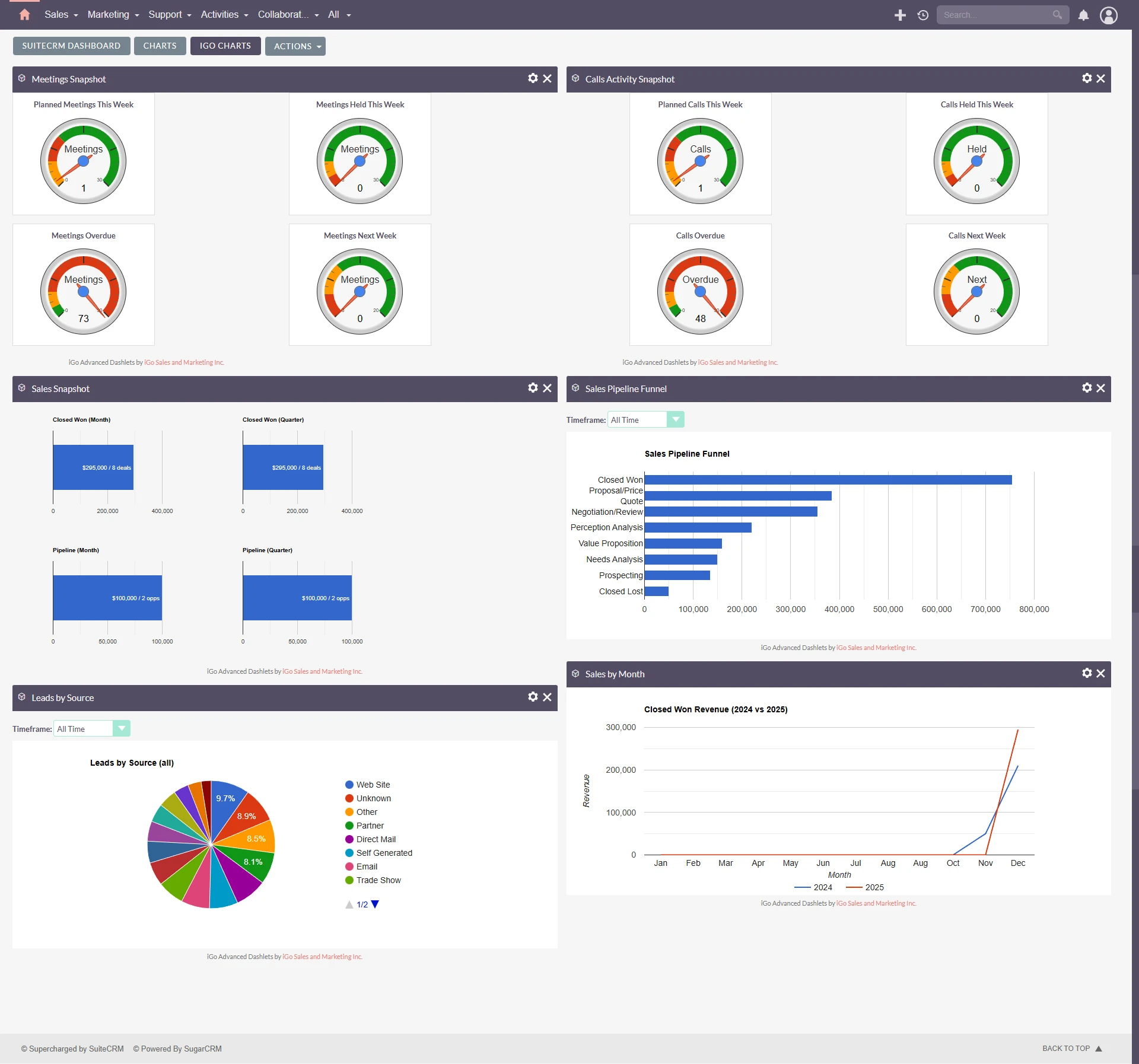
Sales dashboards should answer, at a glance:
- What moved this week?
- What stalled?
- Where are deals getting stuck?
- Are we managing revenue — or hoping?
This is exactly why I built the iGo Advanced Dashboards for SuiteCRM.
They focus on:
- Lead movement and conversion
- Opportunity flow by stage
- Sales velocity and bottlenecks
- Pipeline quality, not just size
They are designed to be used in weekly sales meetings, not buried in reports.
Final Thought for Sales Leaders
If your CRM mainly tells you:
- how busy your reps are
but not: - how deals are progressing
you don’t have sales visibility — you have activity theater.
Measure movement.
Make it visible.
Manage what matters.
If you’re using SuiteCRM and want real sales visibility:
- Download the iGo Advanced Dashboards Plugin
- Use it in your next sales meeting
- See immediately where revenue is actually being created — or lost
Need help implementing or improving SuiteCRM?
I provide SuiteCRM consulting, customization, implementation, and support services to help businesses get more value from their CRM.
